
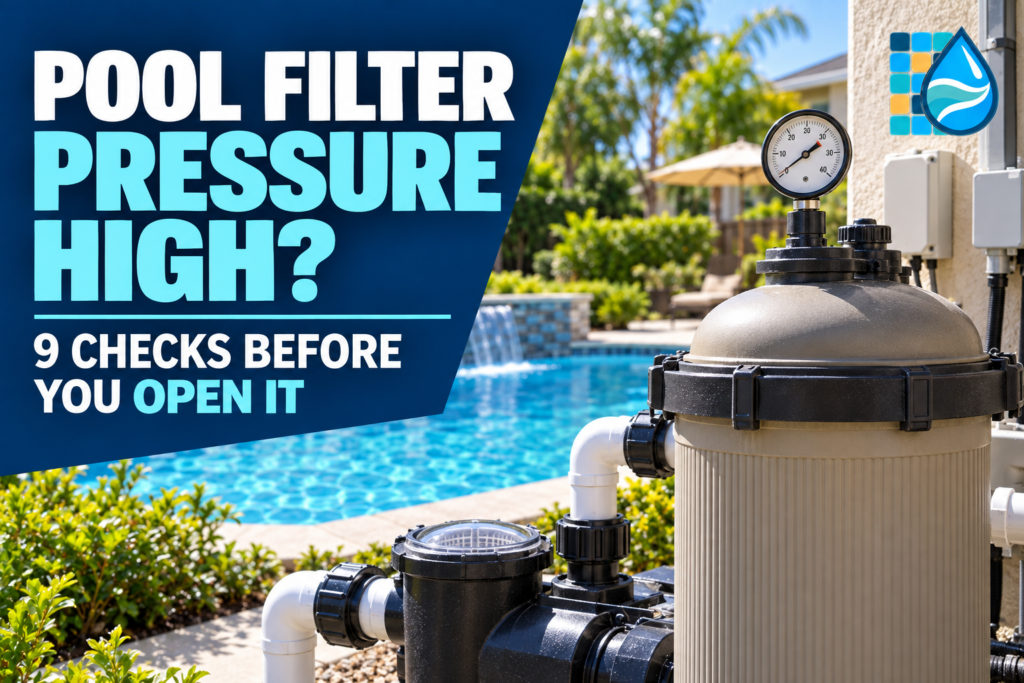
Is your pool filter pressure high? Treat it as a comparison problem, not a universal PSI problem. Compare today’s reading with the clean starting pressure recorded for the same pump speed and valve positions. A rising reading usually means the filter is loading with debris or water is meeting resistance after the pump. A gauge that does not return to zero may simply be giving you bad information.
The dangerous mistake is treating the gauge as permission to open the tank. A pool filter is a pressure vessel. Never loosen a clamp, lid, union, drain plug, gauge, air-relief assembly, or valve while the system is running or pressurized.
Safety first: Shut off the pump, disable schedules and freeze protection, and turn off power as the equipment manual directs. Open the filter’s manual air-relief valve, stand clear, and wait until all pressure is relieved and the gauge reads zero. If the gauge will not return to zero, the tank is damaged, or you cannot identify the correct shutdown procedure, stop and call a qualified pool professional.
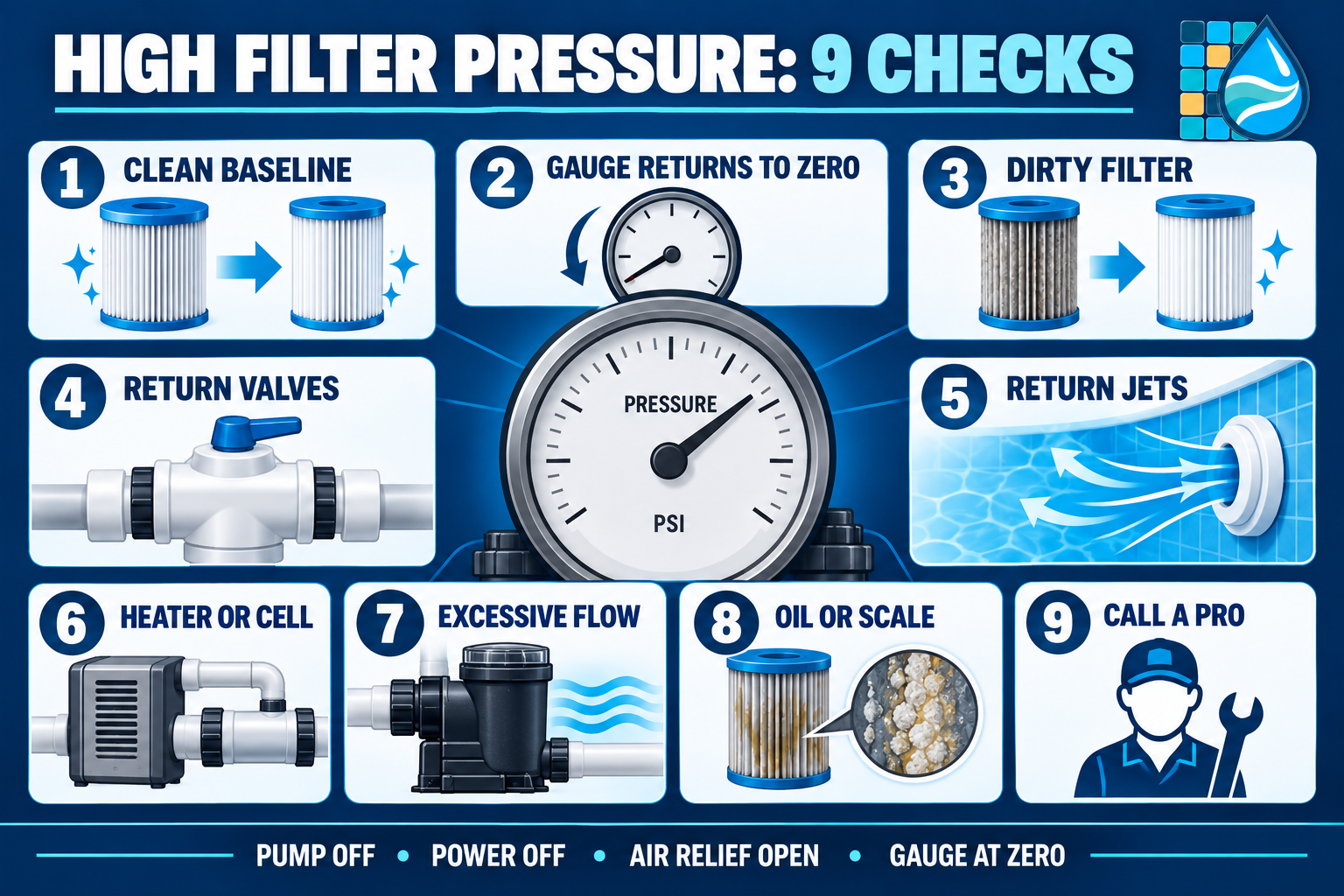
Pool filter pressure high? Start with these checks
If your pool-filter pressure is high:
- Compare it with the clean baseline at the same pump speed.
- Verify that the gauge returns to zero when the system is safely depressurized.
- Check return flow and look for a high-pressure/low-flow pattern.
- Clean or backwash the filter only according to its exact manual.
- Confirm that return valves, fittings, and water-feature lines are open as intended.
- Verify the multiport or backwash valve position with the pump off.
- Consider oils, algae, minerals, or new-plaster dust if pressure rises again quickly.
- Check whether pump speed, plumbing, or equipment recently changed.
- Escalate cracks, leaks, trapped air, repeated pressure rise, or unknown restrictions to a professional.
What is “normal” pool-filter pressure?
There is no single normal PSI for every pool. Pressure changes with pump speed, pipe size, filter type, filter cleanliness, valve position, return fittings, heaters, chlorinators, water features, and elevation. A number that is normal on one pad can be wrong on another.
The useful reference is the clean starting pressure: the stable reading after the filter has been correctly cleaned or backwashed, reassembled, purged of air, and returned to its normal operating configuration. Record the pump speed, valve positions, and clean pressure together. A phone photo and a dated equipment log work well.
Many Pentair residential-filter manuals use an increase of roughly 8–10 PSI above that clean starting pressure as a cleaning signal, but the exact trigger belongs to the installed filter’s manual. Do not substitute that range for the manufacturer’s instructions or the filter’s maximum rating.
Read pressure and flow together
| What you observe | More likely direction | First check |
|---|---|---|
| Pressure is higher than the clean baseline and returns are weaker | Dirty filter media or a restriction after the pump | Filter condition, return valves, heater, chlorinator, and return fittings |
| Pressure is high but flow still looks normal after a speed increase | More pump flow, a changed configuration, or an inaccurate gauge | Pump speed and the gauge at shutdown |
| Gauge stays above zero after safe depressurization | Faulty or obstructed gauge/air-relief assembly | Keep the system off and follow the manual or call a professional |
| Pressure is low and return flow is weak | Suction-side restriction, air leak, low water, or impeller problem | Water level, skimmer and pump baskets, prime, and suction plumbing |
| Pressure rises again soon after cleaning | Algae, oils, mineral scale, plaster dust, damaged media, or an undersized/overloaded filter | Water condition, cleaning method, media condition, and system design |
This distinction prevents a common mistake: repeatedly cleaning a filter when the real problem is a closed return valve, restricted heater, mispositioned multiport valve, or bad gauge.
1. Establish the clean baseline
Do not judge the gauge from memory. Find the pressure recorded after the last correct cleaning, or establish a new baseline after servicing the filter exactly as its manual requires.
For a useful comparison, keep these conditions the same:
- pump speed or flow setting;
- pool-versus-spa mode;
- suction and return valve positions;
- open or closed water-feature circuits;
- heater bypass position;
- cleaner or booster-pump operation.
A variable-speed pump can change filter pressure substantially when its speed changes. Comparing today’s high-speed reading with last week’s low-speed reading does not tell you whether the filter is dirty.
2. Verify the pressure gauge
The gauge is the primary indicator only if it works. When the pump is off and the filtration system has been fully depressurized according to the manual, the needle should return to zero. The face should be readable, the lens intact, and the needle responsive during normal operation.
Treat these as gauge problems:
- the needle remains above zero after pressure is safely relieved;
- the needle does not move when the system starts;
- the reading jumps, sticks, or changes after tapping the face;
- the lens is cloudy, cracked, or filled with water;
- the gauge or air-relief body leaks.
Do not remove the gauge from a pressurized filter. Pentair manuals describe the pressure gauge and manual air-relief valve as critical safety components. If either is damaged or questionable, keep the pump off until the correct replacement or professional service is arranged.
3. Check the actual return flow
Walk to the pool and feel or observe the returns without blocking them. Compare the flow with normal operation. High pressure together with reduced return flow points toward resistance on the pressure side of the system—often a dirty filter or a restriction after it.
Also look for air bubbles at the returns, a pump basket that will not stay full, or surging water. Air entering the system is a separate hazard because compressed air can store energy inside the filter. Use the pool pump losing-prime guide if the pump is drawing air or losing water.
If the pressure is low rather than high and flow is weak, start with pool water level, the pool skimmer checks, pump basket, suction valves, and prime. A clogged suction path typically does not create the same high-filter-pressure pattern as a return-side restriction.
4. Service the correct filter type
If pressure has risen by the amount specified in the manual and return flow has declined, the filter may simply be loaded with debris. The correct service depends on the filter:
- Cartridge filter: remove and clean the cartridges only after full shutdown and depressurization. Follow the cartridge-filter cleaning guide and the installed manual.
- Sand filter: backwash and rinse only when the manual calls for it. Do not move the multiport valve with the pump running.
- D.E. filter: follow the model-specific backwash, disassembly, grid-cleaning, and D.E. recharge instructions. Running without the required media can damage internal components and reduce filtration.
Do not open the filter merely because the gauge looks high. First verify the gauge, establish the baseline, shut down all automatic starts, open the manual air relief, stand clear, and confirm zero pressure. The broader pool-filter cleaning guide explains the differences among filter types.
5. Look for restrictions after the filter
A clean filter can show high pressure when water cannot leave the pressure side freely. With the pump off, compare the valve and plumbing layout with the documented normal positions. Check for:
- a return valve that is closed or partly closed;
- a winterizing plug left in a return;
- small or obstructed return-eyeball fittings;
- a water-feature valve that changed position;
- a check valve that is stuck or installed incorrectly;
- a restricted heater, chlorinator, salt cell, or inline device;
- a kinked flexible hose on an above-ground system;
- recent plumbing work that added resistance.
Never run the pump against a closed return path. Jandy and Pentair manuals warn that closed discharge valves can create hazardous back pressure and damage equipment. If the restriction is inside a heater, salt system, or glued plumbing, arrange qualified service rather than improvising a bypass.
6. Confirm the multiport or backwash valve position
On a sand or D.E. system, a mispositioned or damaged multiport or slide valve can restrict flow or route it incorrectly. Turn the pump off before changing any valve position. Then verify that the handle is fully seated in the position required for normal filtration.
The pool multiport valve positions guide explains Filter, Backwash, Rinse, Waste, Recirculate, Closed, and Winter settings. Closed is never a running position. If the handle is loose, difficult to move, leaking to waste, or will not seat, stop and use the valve manual or a pool professional.
7. Investigate rapid pressure rise after cleaning
A pressure increase that returns quickly after a correct cleaning is useful evidence. Common contributors include:
- active algae or large amounts of fine suspended debris;
- new-plaster dust;
- pollen, ash, soil, or storm debris;
- body oils, sunscreen, and other organic coating on cartridges;
- calcium or mineral deposits that water alone did not remove;
- collapsed, damaged, or incorrectly installed cartridges or grids;
- a filter that is undersized for the debris load or flow.
Do not acid-clean media until oils have been removed by the method approved for that filter; acid can set some organic contamination into the media. Do not mix cleaning chemicals. Correct the water problem as well as the filter symptom, or the pressure will climb again. The cloudy-water guide helps identify suspended debris, algae, and chemistry issues.
8. Check pump speed and system changes
Higher flow creates more resistance, so a variable-speed pump set faster than usual can raise the gauge even with a clean filter. Compare the current setting with the clean-baseline setting. Do not lower speed blindly if the pool, heater, salt system, cleaner, or water feature requires a minimum flow; use the equipment manuals.
Ask what changed immediately before the high reading:
- Was the pump program edited?
- Was a new pump or motor installed?
- Were return fittings made smaller?
- Was a heater, salt cell, check valve, or water feature added?
- Were valves repositioned after service?
- Was the filter media replaced with the correct parts?
The pump’s flow must remain within the filter and plumbing ratings. A pump that can exceed the filter’s design flow needs a system-level review, not a guess at RPM. Use the pool-equipment glossary to label each component before changing anything.
9. Know when to stop and call a professional
Keep the system off and call a qualified pool professional when:
- the filter tank, lid, clamp, lock ring, valve, or plumbing is cracked, distorted, leaking, or missing parts;
- air remains trapped or the manual air relief will not produce a steady stream of water during the approved restart procedure;
- the gauge does not return to zero after depressurization;
- pressure rises immediately after a correct cleaning;
- a return-side restriction is suspected inside a heater, salt cell, check valve, or underground line;
- the pump may exceed the filter’s flow rating;
- the correct valve positions, parts, or shutdown procedure are unknown;
- the breaker trips, water reaches electrical equipment, or gas-heater service is involved.
Do not tighten a clamp, open a tank, or move a valve as a “test” while the pump is running. Do not use compressed air to pressure-test the filter.
Frequently asked questions
Why did my filter pressure suddenly go up?
A sudden rise can follow a pump-speed change, a closed or partly closed return valve, a mispositioned multiport valve, or a downstream restriction. A gradual rise is more consistent with debris loading the filter. Compare the clean baseline, pump speed, flow, and recent changes before opening anything.
Can I run the pool with high filter pressure?
Do not keep running if pressure is abnormally high for the system, flow is restricted, equipment is leaking, or the cause is unknown. Shut down safely and use the installed manuals. A filter is a pressure vessel, and continued operation against a blockage can damage equipment or create a separation hazard.
Does high pressure always mean the filter is dirty?
No. A dirty filter is common, but a faulty gauge, closed return valve, blocked return, excessive pump flow, mineral-coated media, heater problem, or other pressure-side restriction can produce the same reading.
Why is pressure high after I cleaned the filter?
First verify that the gauge returns to zero and that the pump speed and valve positions match the clean baseline. Then consider mineral or oil deposits, incorrectly installed or damaged media, a discharge-side restriction, or excessive flow. Stop if the lid, clamp, air relief, or gauge is not operating correctly.
Should I backwash at a specific PSI?
Use the rise above your clean starting pressure and the exact filter manual—not a universal PSI. Many manuals use a range near 8–10 PSI above the starting pressure, while other filters use a different indicator or procedure.
Why is my filter pressure low and the flow weak?
Low pressure with weak flow more often points to limited water reaching the pump: low pool water, clogged baskets, a suction restriction, an air leak, loss of prime, or an impeller problem. That is a different diagnostic path from high pressure with weak returns.
The bottom line
If your pool filter pressure is high, the gauge means more when it is compared with the clean baseline and actual return flow. Verify the gauge, match the pump speed and valve positions, service the correct filter type, and inspect the return side for restrictions. If the system contains trapped air, damaged pressure components, an unknown blockage, or a gauge that will not return to zero, keep it off and call a professional.
Chris Barnes is a former pool-service company owner with more than seven years of residential and commercial pool-service experience. Swimming Pool Resource turns field experience and current manufacturer guidance into practical steps homeowners can use to troubleshoot, service, and maintain their pools.
References
- Pentair: Clean & Clear Plus Cartridge Filter Installation and User’s Guide
- Pentair: Clean & Clear RP Filter Safety Product Support
- Pentair: FullFloXF C-Series Cartridge Filter Installation and User’s Guide
- Pentair: OptiFlo Aboveground Pool Pump Installation and User’s Guide
- Jandy: Sidemount Composite Sand Filter Installation and Operation Manual