
By Chris Barnes · Former pool-service company owner · 7+ years of residential and commercial experience
Pool pump won’t start? First separate a control or schedule issue from a true power or motor fault. Confirm the intended operating mode, read and photograph any alarm, check the normal disconnect, breaker, and GFCI once without opening an electrical panel, and stop if protection trips again. A dark display, active fault code, click, hum, heat shutdown, or immediate breaker trip points in a different direction. Do not keep cycling the pump while guessing.
Electrical safety: Water and pool equipment create a serious shock hazard. Keep swimmers out if anyone feels tingling or shock, if electrical equipment is wet or damaged, or if protection will not reset. Turn off power from a dry, safe location. Never open a motor, drive, capacitor, wiring compartment, disconnect, breaker panel, or automation enclosure unless you are qualified and authorized to service that equipment. Capacitors can retain hazardous energy after power is removed. Follow the manual for the exact pump and all local electrical requirements.
Pool Pump Won’t Start: The Quick Answer
When a pool pump won’t start, note exactly what is still working before touching anything. Is the display lit? Does the automation system show the pump as available? Is there an error code? Does the motor stay silent, click once, hum, or run briefly and stop? Has a breaker or GFCI tripped? Those observations are more useful than repeatedly pressing Start.
Homeowners can safely check the selected mode, enabled schedule, visible display, obvious exterior debris, and the normal user-operated disconnect or protective device. Reset a breaker or GFCI only when the equipment is dry, the manufacturer allows it, and there is no visible damage, odor, or sign of overheating. If it trips again, leave it off. Supply-voltage testing, wiring correction, motor disassembly, capacitor work, drive repair, and bonding or grounding work belong with qualified professionals.
What the Starting Symptom Usually Tells You
| What you observe | Likely direction | Safest next move |
|---|---|---|
| Display and indicator lights are dark | No supply power, open disconnect, tripped protection, wiring fault, or failed drive | Check only normal user controls; call an electrician or qualified pool professional if power is uncertain |
| Display is on, but Start does nothing | Mode, schedule, interlock, remote-control state, active alarm, or configuration issue | Photograph the screen and compare the mode and code with the exact manual |
| Pump clicks or hums but does not turn | Motor, capacitor, shaft, impeller, or supply-voltage problem | Stop immediately; do not keep retrying or open the motor |
| Pump starts, then shuts off | Heat, blocked ventilation, voltage problem, drive protection, or mechanical load | Leave it off, let it cool, clear only exterior debris, and record the fault |
| Breaker or GFCI trips | Electrical fault, moisture, damaged equipment, or incorrect circuit condition | Do not reset repeatedly; keep power off and arrange qualified diagnosis |
| Motor runs but no water moves | This is a priming, valve, blockage, or suction-side problem—not a start failure | Stop dry running and use the pump-priming diagnostic |
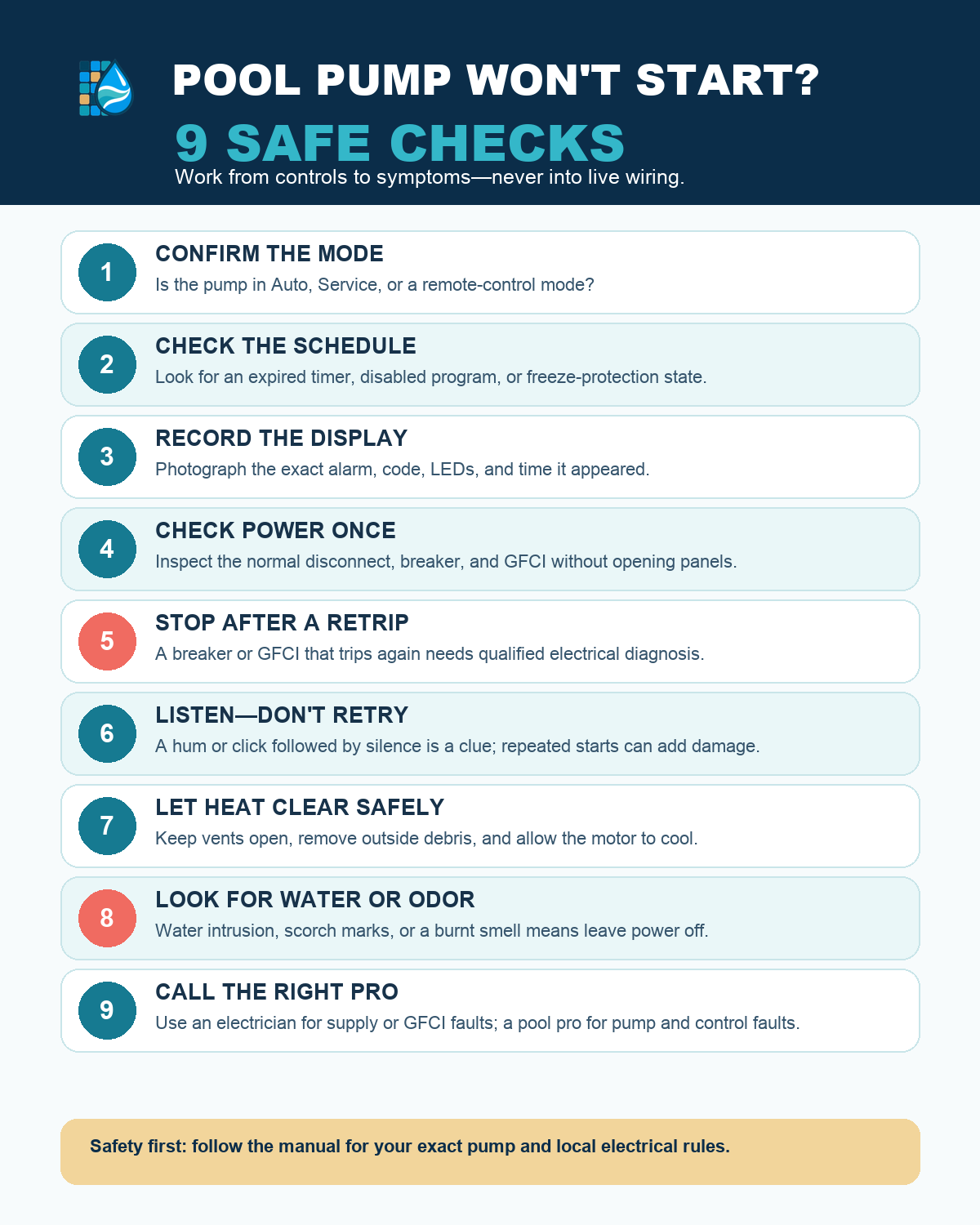
9 Safe Checks When a Pool Pump Won’t Start
1. Confirm the Pump Is Actually Being Asked to Run
Look at the time, selected program, requested speed or flow, and operating mode. Many pool systems can be controlled from the pump keypad, an automation panel, a wall controller, a service switch, or a phone app. One control may show a schedule even though another device has authority. “Auto,” “Service,” “Timeout,” “Remote,” and “Manual” do not mean the same thing across brands.
Use the manual for the exact pump and controller rather than guessing at button combinations. If the system has a clearly documented user mode, return it to its normal setting and issue one normal start command. Do not change installer settings, addresses, voltage selections, or internal switches.
2. Check the Schedule, Freeze Protection, and Interlocks
A schedule may have expired, been disabled, or been overridden. A pool/spa mode, heater demand, freeze-protection routine, water-feature setting, or automation interlock can also change whether the pump accepts a command. Confirm the current time and date after an outage because some controllers lose or alter scheduling information.
Take a photo before changing a setting so you can return to the original configuration. If the pump works locally but not through automation, the problem may be communication or configuration rather than the motor itself.
3. Record Every Display, LED, and Fault Code
Photograph the full screen, not just the code. Include indicator lights, the selected speed, time, mode, and any companion automation message. Write down whether the code appears immediately, after a click or hum, or only after the pump runs for a few minutes.
Do not clear an alarm until you have recorded it. A model-specific manual may distinguish lost communication, drive temperature, supply voltage, motor stall, or another protective condition. Pentair and Jandy documentation both direct users to the displayed fault or alert and the exact pump procedure; the same words can mean different things on a different model.
4. Inspect the Normal Power Controls From the Outside
When a pool pump won’t start, inspect only from a dry, safe location. Look at the user-operated disconnect, breaker, GFCI, timer, and automation panel that normally control the pump. Check for an obvious off position, tripped indicator, power-outage message, wet enclosure, loose cover, scorch mark, insect activity, or burnt odor. Do not remove a cover or reach inside.
The U.S. Consumer Product Safety Commission emphasizes GFCI protection and qualified electrical inspection around pools. If anyone has felt a shock or tingling sensation, keep people out of the water, shut power off safely, and involve a qualified electrician before the pool is used again.
5. Reset a Breaker or GFCI No More Than Once
Only attempt a normal reset when the equipment is dry, no damage or odor is present, and the device manufacturer’s instructions allow it. Move a tripped breaker fully off before returning it to on if that is the documented reset method. Stand on a dry surface and use the normal handle only.
If the breaker or GFCI trips again, leave it off. A repeat trip is not an inconvenience to bypass; it is a protective response that can indicate an electrical problem. Hayward’s pump safety guidance specifically directs users to consult an electrician when a GFCI trips and will not reset. Never install a larger breaker, defeat GFCI protection, hold a breaker on, or use an extension cord as a workaround.
6. Listen Once for Silence, a Click, or a Hum
When a pool pump won’t start, one normal start attempt can provide a useful symptom. Complete silence may support a control, power, or drive diagnosis. A single click can point toward a relay, controller, motor, or supply issue. A steady hum without rotation may indicate a stalled motor, mechanical binding, capacitor problem, or incorrect voltage condition.
Stop after you identify the sound. Repeatedly energizing a humming pump can overheat the motor or worsen damage. Do not remove the motor end cover, reach through an opening, turn an exposed shaft, or test a capacitor yourself. If the pump was making a different sound before it failed, compare it with the pool-pump noise guide and share the timeline with the technician.
7. Check for a Heat Shutdown Without Opening the Pump
A pump that starts cold and stops later is different from a pump that never responds. With power off, inspect the outside of the motor and drive for leaves, mulch, dust, or stored items blocking ventilation. Maintain the clearance required by the manual. Do not spray the motor or drive, remove a cover, or cool hot electrical equipment with water.
Allow the equipment to cool naturally and record the elapsed run time, outdoor temperature, speed, fault message, and whether the filter pressure or flow changed first. Jandy troubleshooting guidance connects periodic hot shutdowns with ventilation and supply-voltage checks; voltage and electrical connections should be evaluated by a qualified professional.
8. Look for Water Intrusion, Damage, or a Burnt Smell
If a pool pump won’t start after rain, irrigation, or a plumbing leak, moisture may have reached electrical parts. A failed shaft seal or loose enclosure can create the same risk. Keep power off if the drive, motor, conduit, disconnect, or automation panel is wet or damaged. A scorched surface, melted plastic, buzzing electrical enclosure, smoke, or burnt odor requires immediate professional attention.
Water beneath the pump is not always an electrical failure, but it should not be ignored. Use the pool-pump leak guide to identify whether the water appears near the lid, plugs, unions, housing joint, or motor-facing shaft-seal area—without energizing questionable equipment.
9. Match the Model and Call the Right Professional
Photograph the pump label, drive label, controller, plumbing layout, and fault screen. Record when the problem began, recent outages or storms, recent plumbing or electrical work, and whether the pump failed silently, hummed, tripped protection, or shut down hot. Use the pool-pump model-number guide if the label is difficult to find.
This evidence can shorten diagnosis and reduce unnecessary replacement. A supply, breaker, GFCI, grounding, bonding, or wiring problem belongs with a qualified electrician experienced with pools. A pump drive, motor, impeller, seal, controller, or automation fault belongs with a qualified pool-equipment professional. Some failures involve both.
A Pool Pump Not Starting Is Not the Same as Not Priming
If the motor or drive is running but the pump basket stays empty, water does not move, or large air bubbles appear, the pump has started—the circulation system has a different problem. Shut it down before it runs dry. Check water level, valve position, baskets, pump-lid seal, and the priming procedure in the exact manual.
Use How to Prime a Pool Pump for startup technique or Pool Pump Keeps Losing Prime? when water drains away again. Weak return flow after the pump is running belongs in the low-flow diagnostic.
Should You Repair or Replace When a Pool Pump Won’t Start?
Do not choose replacement from the symptom alone. An automation setting, tripped protective device, failed external controller, wiring fault, drive problem, damaged motor, mechanical obstruction, or incompatible supply condition can all look like “dead pump” from the pool deck. Replacing the wet end will not correct a supply fault, and replacing a motor will not correct a bad automation command.
Ask for a written diagnosis that identifies the failed part, test result, parts and labor cost, warranty, and whether the replacement must match the existing voltage, plumbing, automation, flow needs, and local efficiency rules. Compare repair cost with the age and condition of the entire unit—not just the price of a bare motor.
When to Stop and Call a Professional
- The breaker or GFCI trips again after one normal reset.
- Anyone feels tingling or shock in or near the pool.
- The motor, drive, disconnect, conduit, or controller is wet, scorched, melted, buzzing, smoking, or smells burnt.
- The pump hums without turning, repeatedly clicks, or starts and stops on heat or fault protection.
- The display reports a voltage, overcurrent, ground, drive, motor, stall, or communication fault you cannot resolve from the exact manual.
- The task requires opening an electrical enclosure, testing live voltage, handling a capacitor, or changing wiring.
- The pump or controls were recently replaced and the supply, configuration, or automation address may be wrong.
For orientation before the service call, review the pool-pump guide for first-time owners and the pool-equipment glossary. Keep the pump off when the condition is unsafe or uncertain.
Pool Pump Won’t Start: Common Questions
Why is my pool pump completely silent?
If the pool pump won’t start and is completely silent, possible causes include a disabled command, incorrect mode, expired schedule, tripped protection, loss of supply power, communication fault, failed drive, or failed motor. Start with the display and normal controls; do not open electrical compartments to investigate.
Why does the pump hum but not start?
A hum can accompany mechanical binding, a motor or capacitor fault, or an incorrect supply condition. Stop after one observation. Repeated attempts can add heat and damage, and capacitor or motor service is not a homeowner task.
Can I keep resetting the pool-pump breaker?
No. When conditions are dry and normal, one reset may confirm whether an isolated outage occurred. If the breaker or GFCI trips again, leave it off and arrange qualified diagnosis. Never increase breaker size or bypass protection.
Why does my pool pump run manually but not on schedule?
If the pool pump won’t start from its schedule but runs manually, the motor may be functional while the clock, program, selected mode, controller authority, communication link, or automation configuration is not. Photograph the current settings and use the pump and controller manuals before changing installer-level options.
Why does the pool pump start and then shut off?
Possible directions include blocked motor ventilation, high ambient heat, supply voltage outside the equipment requirement, excessive mechanical load, or a drive fault. Leave the pump off, let it cool naturally, clear only exterior airflow obstructions, and have a qualified professional test the system.
The Bottom Line
When a pool pump won’t start, the safest diagnosis begins with observation: operating mode, schedule, display, alarm code, protective-device status, sound, heat, moisture, and timing. Check only normal controls from the outside. Stop after a repeat trip, hum, electrical odor, water intrusion, or shock concern, and preserve the evidence a professional needs.
For a personalized next step, send clear photos of the pump label, display, plumbing, and controller through Ask Chris About Your Pool. Do not energize unsafe equipment just to create a photo or video.
Sources and Review Notes
Written and field-reviewed by Chris Barnes. Former Northern California pool-service company owner with more than seven years of residential and commercial experience. Last reviewed September 10, 2026. The exact pump, controller, and protective-device manuals, product labels, and applicable local electrical requirements take priority.