
Pool pump overheating can mean anything from normal operating warmth to blocked cooling, restricted water flow, incorrect voltage, or a motor that is beginning to fail. Do not judge it by touching the housing. Instead, look for a pump that stops and restarts, displays a temperature or drive alarm, smells hot, changes sound, loses water flow, or repeatedly trips protection.
Safety first: Shut the pump off immediately for smoke, a burning or melting odor, sparking, a breaker or GFCI that trips again, severe vibration, water near electrical equipment, a dry pump basket, or a motor that repeatedly stops on thermal protection. Disable schedules and automation so the pump cannot restart unexpectedly. Keep hands dry, stay clear of wet electrical equipment, and leave voltage tests, wiring, drive covers, motor covers, capacitors, and internal repairs to a qualified pool professional or licensed electrician.
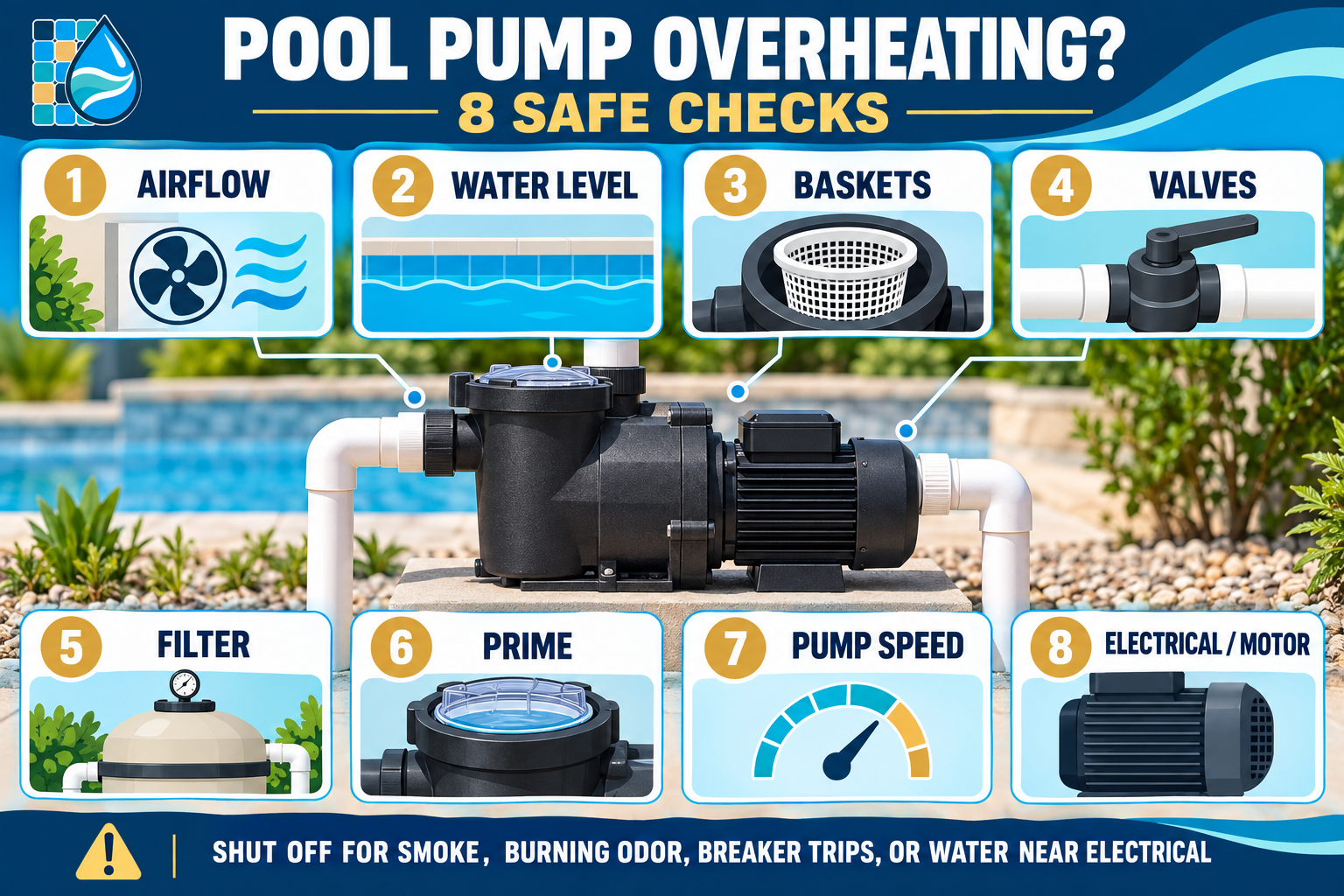
Pool pump overheating? Start with these eight checks
- Give the motor and drive clear, shaded airflow.
- Confirm the pool water level is high enough for steady skimming.
- Empty the skimmer and pump baskets with power off.
- Verify the normal suction and return valves are open.
- Compare filter pressure and return flow with the clean baseline.
- Confirm the pump stays fully primed and is not drawing air.
- Review speed, schedule, water features, and connected equipment.
- Stop for electrical, bearing, drive, or motor warning signs.
Is a hot pool pump always a problem?
No. Electric motors create heat, and a motor sitting in direct summer sun may feel much hotter than the surrounding air. The outside temperature alone does not prove the pump is failing. The better question is whether the pump is operating differently from its normal pattern.
Treat these as meaningful overheating clues:
- the pump shuts itself off and later runs again after cooling;
- the display reports an over-temperature, over-current, voltage, or drive fault;
- the motor sounds rough, squeals, hums, or slows unexpectedly;
- return flow weakens or the pump basket develops a large air pocket;
- the housing has a new burned-plastic or electrical odor;
- a breaker or GFCI trips;
- plastic around the motor, drive, wiring compartment, or conduit looks discolored or distorted.
Modern pumps may use thermal or electronic protection to stop operation before more damage occurs. That shutdown is a warning—not a reason to keep resetting or restarting the pump. Record the exact error, time, pump speed, weather, and valve positions before power is removed. Those details can make service faster.
First identify which part appears hot
A pool pump is an assembly, not one component. Observing the location without touching it helps narrow the problem.
| What you observe | More likely direction | Safe next move |
|---|---|---|
| Motor housing is hot but flow and sound are normal | Normal motor heat, direct sun, or limited ventilation | Improve shade and open-air clearance without enclosing the motor |
| Pump stops, cools, and later runs again | Thermal protection reacting to heat, voltage, airflow, or mechanical load | Leave it off and correct the cause before another restart |
| Drive or control display shows a fault | High ambient temperature, blocked drive cooling, voltage problem, or internal drive fault | Photograph the code and follow the exact model manual |
| Pump basket is low, bubbly, or empty | Lost prime, low water level, suction restriction, or air leak | Shut down before dry running damages the seal or wet end |
| Flow is weak and filter pressure is unusual | Restricted suction, dirty filter, valve position, blocked return, or wrong speed | Diagnose the circulation path rather than extending run time |
| Rough growl, screech, or worsening vibration | Bearing, fan, impeller, mechanical binding, or debris rubbing | Keep the pump off and arrange professional inspection |
| Burning odor, smoke, sparking, or repeated breaker trip | Electrical or motor hazard | Turn off power at a safe upstream disconnect and call a professional |
Do not spray the motor with water, cover it with a sealed box, aim a lawn sprinkler at it, or place wet towels or ice on it. A pump needs weather protection and ventilation—not added moisture or blocked airflow.
1. Give the motor and drive clear, shaded airflow
Pool-pump motors and variable-speed drives shed heat into the surrounding air. Direct sun, a tight equipment enclosure, overgrown plants, accumulated leaves, landscape fabric, or stored objects can trap that heat. Manufacturer guidance commonly calls for ventilation and warns against debris around the motor.
With power off and the pump unable to restart, inspect the outside of the motor and drive. Remove loose leaves and objects around the equipment without opening any cover. Restore the clearance required by the installed manual. If the pump is in a shed or cabinet, confirm that vents are open and the enclosure is designed to keep rain out while allowing heat to escape.
Shade can help, but do not drape a cover over the pump or block the motor’s air openings. Any permanent shade structure must preserve service access, drainage, ventilation, and electrical clearances.
2. Confirm the pool water level
Low water can let the skimmer pull air. The pump may surge between water and air, lose prime, or run with too little water in the wet end. The motor’s external cooling and the pump’s water-handling parts are different systems, but poor prime can still damage the shaft seal and create heat where the pump should be moving water.
The water level should normally sit around the middle of the skimmer opening, subject to the pool and skimmer design. Look for a skimmer weir that is stuck, a vortex in the skimmer, gulping sounds, bubbles below the clear pump lid, or bursts of air at the returns.
If the basket is not staying full, shut the pump off. Restore the correct water level and use the pool-pump losing-prime guide before restarting repeatedly.
3. Empty the skimmer and pump baskets
Packed baskets restrict suction and make the pump work under poor hydraulic conditions. With power off, schedules disabled, and the pump isolated only as its plumbing and manual require, clean the skimmer basket and pump strainer basket. Do not reach into the pump opening or impeller area unless the exact manual allows it and power is locked out.
Inspect the pump-lid O-ring and sealing surface before reassembly. A lid that is not sealed can introduce air and prevent stable prime. If the basket repeatedly fills with leaves, improve surface cleaning and address the debris source rather than allowing the pump to operate starved for water.
After a correct restart, watch for steady water under the clear lid. Persistent bubbles or a growing air pocket point to a suction-side problem, not a reason to run the motor longer.
4. Verify normal valve positions
A closed or badly restricted suction valve can starve the pump. A closed return valve can dead-head the system and create unsafe pressure. Before moving anything, photograph the current valve positions and identify where each pipe goes.
With the pump off, confirm the normal circulation path is open according to the equipment labels and system design. Check that an actuator has not stopped between positions and that a recent spa, cleaner, water-feature, or maintenance setting was not left active.
Never run a multiport valve in Closed, and never move a multiport handle while the pump is running. If the pad is not labeled, use the pool-equipment glossary and have the plumbing mapped before experimenting.
5. Compare filter pressure and return flow
The pressure gauge and return jets help show where circulation is restricted. Compare the current reading with the filter’s own clean baseline at the same pump speed and valve positions. One universal pressure number does not fit every pool.
- Higher-than-baseline pressure with weak returns can point to a dirty filter, blocked return, closed valve, or downstream restriction.
- Lower-than-baseline pressure with weak returns can point to low water, clogged baskets, an air leak, blocked suction, a clogged impeller, or low pump speed.
- Normal pressure with a hot motor shifts attention toward ambient heat, airflow, electrical supply, drive settings, bearings, or the motor itself.
If pressure is high, follow the high-filter-pressure checklist. If overall circulation is weak, use the low-pool-flow guide instead of asking a restricted pump to run harder or longer.
Treat the filter as a pressure vessel. Never open, loosen, or service it until power is off, the manual air relief is open, water and air have stopped escaping, and the gauge reads zero.
6. Confirm the pump stays fully primed
A properly operating pump should move a continuous column of water. A large persistent air pocket, surging flow, visible bubbles at the returns, or a pump that drains after shutdown suggests a suction-side air leak, low water, an obstruction, or a check-valve problem.
Do not let the pump run dry while you wait for it to recover. Shut it down, correct the water and suction conditions, then follow the installed manual. The safe pump-priming guide explains the basic sequence, and the pool-pump air-leak guide helps locate common suction-side clues.
If the pump will not prime within the manual’s allowed time, stop. Repeated dry starts can damage the shaft seal and pump components.
7. Review pump speed, schedule, and operating mode
A variable-speed pump may run at different speeds for filtration, heating, cleaning, spa jets, water features, or sanitation. A recent schedule or automation change can leave it at a high speed for longer than expected. That can expose an existing ventilation, voltage, or mechanical problem and may also raise filter pressure.
Review the controller history and compare the current program with the normal schedule. Note whether overheating happens only during a high-speed feature, heater call, spa mode, or cleaner cycle. Do not lower the speed blindly if a heater, salt system, cleaner, or water feature requires minimum flow.
Use the daily pump-schedule guide to set the lowest effective speed and duration that still supports circulation, sanitation, and connected equipment. A schedule adjustment should not be used to hide a pump that is tripping protection or making abnormal noise.
8. Stop for electrical, drive, bearing, or motor clues
Incorrect supply voltage, loose or undersized wiring, overloaded circuits, poor connections, drive faults, bearing damage, a rubbing fan, or a mechanically bound impeller can create excess heat. These problems require proper instruments, model-specific procedures, and electrical safety training.
Homeowners can safely record external evidence: the model and serial number, exact display code, breaker behavior, speed, time of day, sound, vibration, and whether the problem began after electrical work, a storm, a power outage, or equipment service. The model-number guide shows where to find the identifying label without opening the equipment.
Do not remove a motor or drive cover, touch a capacitor, tighten electrical terminals, bypass a safety device, substitute a larger breaker, or repeatedly reset a tripping breaker. A qualified technician should verify the operating voltage, current, wiring, terminations, programmed motor data, shaft movement, bearings, fan, impeller, and drive diagnostics against the manufacturer’s specifications.
A safe 10-minute homeowner check
If there is no smoke, burning odor, sparking, severe vibration, repeated breaker trip, or water near electricity, use this short sequence:
- Turn the pump off and disable every schedule or automation that could restart it.
- Photograph the display, error code, valve positions, filter pressure, and equipment pad.
- Let the pump cool for the period required by its manual.
- Clear loose leaves and stored objects from the motor’s external airflow area.
- Check the pool water level and skimmer weir.
- Empty the skimmer and pump baskets using the manual’s shutdown procedure.
- Confirm the normal suction and return paths are open.
- Inspect through the pump lid for a clean basket, adequate water, and a correctly seated lid seal.
- Restart once only if the manual allows it and no stop condition is present.
- Observe from a dry, safe position. Stop if prime, flow, sound, pressure, or temperature protection is not normal.
If the pump trips protection again, leave it off. Repetition adds heat without fixing the cause.
Repair the pump or replace it?
An overheating complaint does not automatically require a new pump. Debris, inadequate ventilation, a dirty filter, an air leak, a valve error, or a schedule problem may be correctable. A model-specific repair may make sense when the pump housing, wet end, and drive are sound and supported parts remain available.
Replacement becomes more likely when the motor windings, drive, bearings, or multiple major components have failed; the housing or electrical compartment is damaged; corrosion is extensive; parts are obsolete; or the pump is incorrectly sized for the hydraulic system. Compare the complete installed cost, warranty, code requirements, automation compatibility, and expected operating cost—not just the price of a motor.
Have the system evaluated before increasing horsepower. A larger pump on the same plumbing can increase velocity, noise, energy use, and filter pressure without correcting a restriction.
Common mistakes that make overheating worse
- Restarting a pump every time thermal protection resets.
- Assuming a hot housing proves motor failure without checking flow and ventilation.
- Running the pump dry while trying to restore prime.
- Blocking cooling openings with a tarp, box, vegetation, or stored chemicals.
- Spraying water on the motor or drive to cool it.
- Increasing breaker size or bypassing a GFCI or safety control.
- Opening a drive, motor, wiring compartment, or capacitor enclosure without qualification.
- Running against closed valves or an overloaded filter.
- Extending run time to compensate for weak circulation.
- Replacing the pump before recording the error code, model, speed, and operating conditions.
Frequently asked questions
Why does my pool pump get hot and shut off?
It may be opening thermal or electronic protection because of high ambient temperature, blocked ventilation, incorrect voltage, an overloaded or mechanically binding motor, a drive fault, or another abnormal condition. Leave it off after a repeated shutdown and have the cause identified rather than waiting for it to reset again.
Can direct sunlight make a pool pump overheat?
Direct sun can add significant heat, especially around a dark motor or a poorly ventilated enclosure. Use a properly designed shade structure that keeps the equipment dry and preserves the clearances and airflow required by the manual. Do not wrap or tightly cover the pump.
Can a dirty filter overheat the pump?
A dirty filter usually shows up as higher pressure and weaker return flow. It changes the hydraulic load and can contribute to poor system performance, but motor overheating can also have airflow, electrical, drive, or mechanical causes. Compare pressure at the same speed with the filter’s clean baseline and diagnose the full circulation path.
Will a pool pump restart after it cools down?
Some motors or drives can restart after thermal protection resets; others require a manual reset or service action. Because schedules and automation may also command a restart, disable them before inspection. A restart does not prove the problem is solved.
Should I spray water on a hot pool-pump motor?
No. Water around motors, drives, conduit, and connections creates an electrical hazard and can damage equipment. Turn the pump off safely, keep the area dry, allow it to cool, and correct airflow or call a qualified professional.
Can low voltage make a pool pump overheat?
Yes. Manufacturer manuals warn that incorrect voltage can cause overheating and shorten motor life. Voltage and current must be measured under operating conditions by qualified personnel; do not open the wiring compartment or test energized equipment yourself.
What information should I give a pool technician?
Provide the pump make, exact model and serial number, photos of the equipment pad and display, the error code, pump speed, schedule, valve positions, filter pressure, recent weather, and a short description of the sound, smell, shutdown pattern, and recent changes.
The bottom line
For pool pump overheating, diagnose the operating pattern—not the housing by touch. Start with airflow, water level, baskets, valves, filter pressure, prime, and speed. Stop immediately for smoke, burning odor, sparking, water near electricity, dry running, repeated protection trips, or severe noise and vibration. When the evidence points to voltage, wiring, the drive, bearings, or the motor, keep the pump off and call a qualified professional.
Chris Barnes is a former pool-service company owner with more than seven years of residential and commercial pool-service experience. Swimming Pool Resource turns field experience and current manufacturer guidance into practical steps homeowners can use to troubleshoot, service, and maintain their pools.
Need help narrowing down the heat source? Ask Chris about your pool and include one wide equipment-pad photo, one close-up of the pump label, and the exact display code or shutdown pattern.