
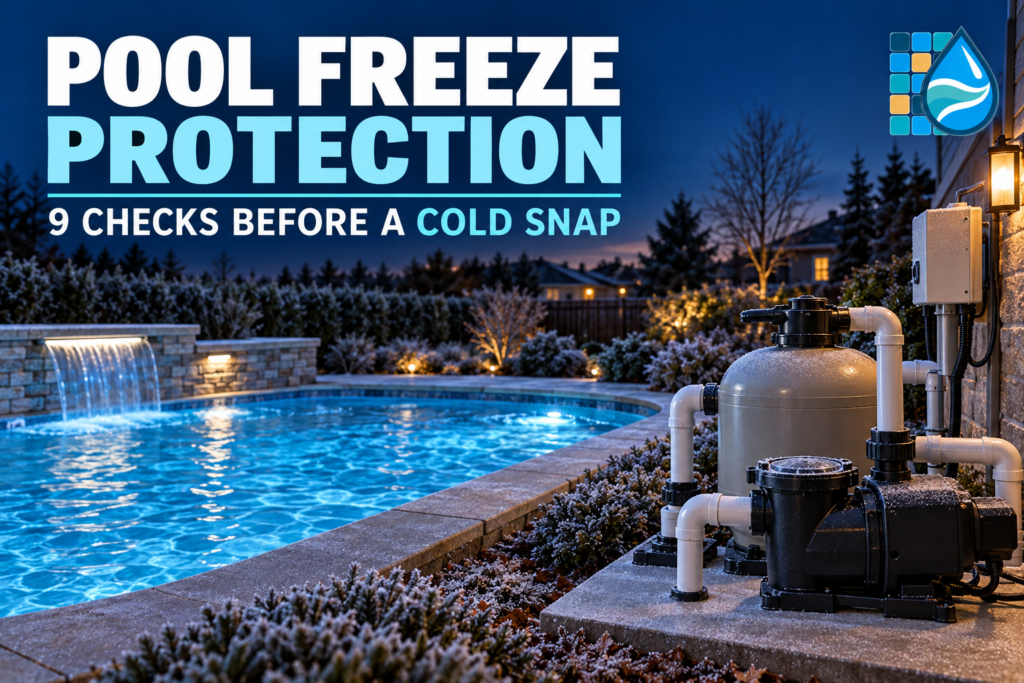
Pool freeze protection is a short-weather-event plan for a pool that remains open—not a substitute for draining and winterizing a system that will face sustained freezing. During a brief cold snap, correctly configured circulation can reduce the chance that water freezes inside exposed plumbing and equipment. It cannot protect every water path, and it stops helping if the power, pump, sensor, controller, or water flow fails.
This guide helps you inspect an operating pool before freezing weather, confirm what its automation actually protects, and plan for a power outage. Exact temperature settings, pump speeds, valve positions, and drainage procedures depend on the installed equipment and its manuals.
Safety first: Do not open a filter, pump lid, union, valve, heater, or drain plug while the system is running or pressurized. Prevent automatic restarts before servicing equipment. Keep portable heaters, extension cords, and open flames away from wet equipment. If water reaches a motor, controller, conduit, breaker, or damaged wiring, keep clear and call a qualified professional.
The quick answer
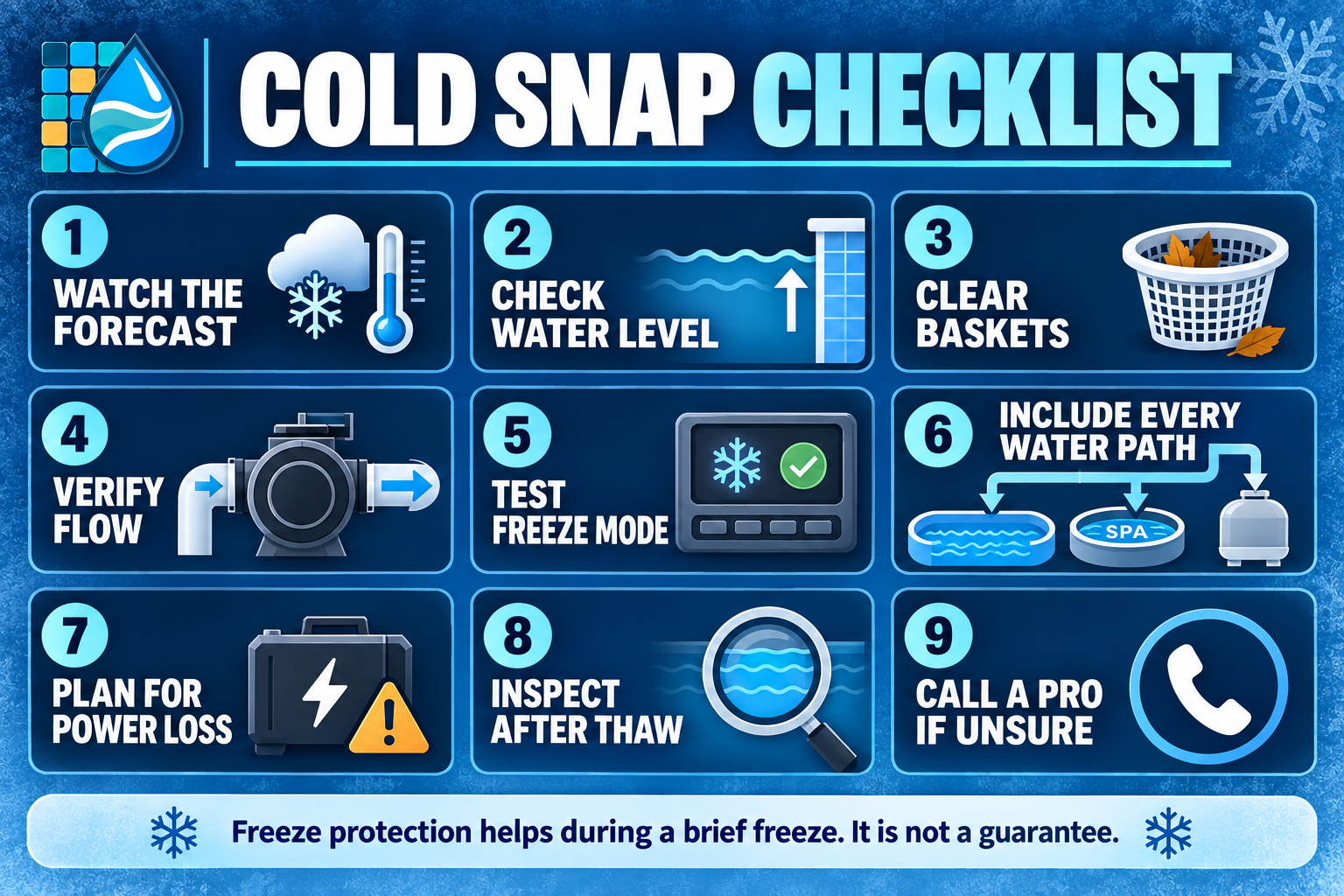
For practical pool freeze protection before a brief freeze:
- Watch the forecast and the duration of the cold.
- Check that the pool has enough water for normal circulation.
- Clear skimmer and pump baskets so flow is not restricted.
- Verify normal flow at the returns and water features.
- Test the installed freeze-protection mode before the weather arrives.
- Confirm that every vulnerable water path is included.
- Make a written plan for a power or equipment failure.
- Inspect the pad during the event and again after thawing.
- Call a pool professional when the layout or shutdown procedure is uncertain.
Pool freeze protection or full winterization?
| Situation | Better plan | Why |
|---|---|---|
| A short, unusual overnight freeze where the pool normally stays open | Verify circulation-based freeze protection and monitor the system | Moving water can reduce risk while power and flow remain available |
| Repeated or sustained freezing weather | Follow the complete closing plan for the pool and equipment | Automation is not designed to guarantee protection through extended freezing |
| A storm with a meaningful outage risk | Prepare both an operating plan and a model-specific shutdown or drainage plan | Freeze mode cannot run without power or a functioning pump |
| Unknown plumbing, water features, solar lines, or equipment manuals | Arrange professional inspection before the freeze | One unprotected branch or trapped low point can still freeze |
The new pool winterization guide covers a complete seasonal closing. This article is for the different problem of protecting a pool that will stay open through a short freeze.
1. Watch the forecast—not just the overnight low
Start early enough to inspect the system in daylight. The National Weather Service describes a Freeze Watch as advance notice that widespread freezing may occur and a Freeze Warning as a signal to take action. Use the forecast for your location, not a general regional temperature.
Look beyond one number:
- How many hours may remain below freezing?
- Will wind expose the equipment pad or above-ground plumbing?
- Is a power outage possible?
- Is the equipment in a protected enclosure or an exposed low area?
- Does the pool have a raised spa, waterfall, solar loop, cleaner booster, or other branch that can trap water?
A shaded or windy equipment pad can cool differently from the weather station. An automation sensor can also be poorly placed, disconnected, or inaccurate. The forecast gives you time to verify the system; it does not prove that freeze mode will work.
2. Check the water level before the cold arrives
An operating pump needs a stable supply of water. If the water is too low for the skimmer to draw normally, the pump can pull air, lose prime, overheat, or stop circulating the very lines you are trying to protect.
Bring the pool to its normal operating level using the pool builder’s guidance. Check the skimmer weir and remove anything that can hold it closed. If the pool is already losing water, do not assume topping it off solves the cause; use the pool leak checks and arrange repair if the level cannot remain stable.
Avoid creating icy walking surfaces around the equipment pad. Add water early enough that hoses can be disconnected and stored before temperatures fall.
3. Clear the baskets and obvious flow restrictions
Pool freeze protection depends on actual circulation, not merely a glowing pump display. Empty the skimmer and pump baskets while the equipment is off, isolated from automatic starts, and depressurized as the manuals require. Remove heavy leaves from the pool before they reach the skimmer.
Inspect the pump lid and its seal while the lid is already open for normal basket service. Clean the sealing surfaces and follow the pump manual for the O-ring and lid. A suction-side air leak can reduce flow and make the pump harder to prime.
If the filter pressure is abnormally high or flow is weak, diagnose that condition before the freeze. Do not open a pressurized filter or move a multiport valve while the pump is running. The filter-cleaning guide and multiport-valve guide explain the safe preparation steps.
4. Verify circulation through the real plumbing paths
Run the pool in its normal filtration mode and confirm that the pump primes fully, the filter pressure is close to its clean baseline at the same speed, and the returns have normal flow. Look through the pump lid only if the design permits safe visual inspection; do not loosen it while running.
Walk the equipment pad and pool perimeter. Check for:
- bubbles returning to the pool;
- a pump basket that will not remain full;
- weak skimmer draw or weak return flow;
- leaks at lids, plugs, unions, valves, or equipment joints;
- unusual pump noise, cycling, alarms, or breaker trips;
- a valve position that blocks a feature or body of water.
Do not run damaged or leaking equipment unattended. The pool pump losing-prime guide and pump leak guide can help separate a suction-side air problem from a visible water leak.
5. Test freeze mode before you need it
Automatic pool freeze protection usually relies on an air-temperature sensor, controller settings, an assigned circuit, and a working pump. Manufacturer systems differ. Some allow a start temperature and pump speed to be configured; some protect the main filtration circuit by default; some require additional circuits to be assigned separately.
Use the exact controller and pump manuals to answer these questions:
- Is freeze protection enabled?
- Which air sensor controls it, and does the displayed temperature seem reasonable?
- Which pump and auxiliary circuits are assigned?
- What speed or flow will the pump use?
- Will a manual mode, schedule, spa command, service mode, or communication failure override it?
- Does the system resume automatically after an outage?
Test while temperatures are mild using only the manufacturer’s approved test or service procedure. Confirm physical water movement instead of relying only on an app status. Do not copy a neighbor’s activation temperature or pump speed; the correct settings depend on the equipment, plumbing, sensor, and local conditions.
Pentair’s IntelliSync guide notes that the main circulation pump is protected only when the feature is enabled and describes separate start, stop, and pump-speed settings. Jandy’s AquaLink documentation warns that freeze protection is intended for short freezes and can be overridden in some operating modes. Those details are why the installed manual matters.
6. Include every vulnerable water path
The main pump can be running while another branch remains still. A pool-and-spa system may have multiple valve positions, and water features, solar plumbing, cleaner lines, booster pumps, heaters, and exposed bypass loops may need separate protection.
Make a simple equipment-path map using the pool equipment glossary. Trace water from each suction source through the pump and treatment equipment to every return destination. Then compare the map with the circuits assigned to freeze protection.
Pay special attention to:
- a raised spa and its separate suction or return paths;
- waterfalls, deck jets, laminars, fountains, and slides;
- solar collectors and rooftop plumbing;
- cleaner and booster-pump lines;
- heater bypasses and check valves;
- exposed pipes, dead ends, and low points;
- equipment that was recently isolated for repair.
Do not experiment with unfamiliar valves during freezing weather. An incorrect position can stop flow, deadhead a pump, isolate a water-filled branch, or change spa water level. Have a professional document the normal and freeze positions before the event.
7. Plan for a power outage or pump failure
Circulation-based pool freeze protection has a single obvious weakness: it ends when circulation ends. Internet service, an app, or a remote alert can fail too. Write down what you will do if the pump stops, a breaker trips, the controller goes offline, or the utility reports a long outage.
The plan should include:
- the pool professional and utility contact information;
- the equipment manuals and model numbers;
- the normal valve positions and freeze-protected circuits;
- the location of the pool-equipment electrical disconnect;
- the model-specific shutdown or drainage instructions approved for your system;
- a rule to stop before opening, draining, or forcing any component you cannot identify.
If extended freezing or an outage is likely, contact a qualified pool professional before the storm. Do not improvise with compressed air, automotive antifreeze, open flames, heat guns, extension cords, or unattended portable heaters. Do not drain the pool itself unless the builder or a qualified professional specifically directs it; over-draining can damage liners and structures or create groundwater problems.
If equipment is already frozen, do not force a lid, plug, valve, or pump to operate. Prevent automatic restart and get model-specific help.
8. Inspect during the event and after the thaw
When conditions are safe, visually confirm that the pump remains on and water is moving through the intended paths. Stay off icy decking and keep hands away from wet electrical equipment. A phone or automation alert is useful, but it does not replace a physical flow check.
After temperatures rise, inspect again before returning to the normal schedule. Freeze cracks may not leak until ice melts and pressure returns. Look for new moisture, split fittings, distorted lids, damaged gauges, loose plugs, air in the pump, unusual pressure, alarms, or a pump that sounds different.
Shut the system down if water is reaching electrical equipment, a housing is cracked, a line has separated, the pump will not prime, or the filter cannot be safely pressurized. Do not patch a structural crack or energize wet equipment as a test.
9. Call a professional when the system is unclear
A professional freeze inspection is a good investment when:
- the plumbing paths are unknown or recently modified;
- the property has a pool-spa combination or several water features;
- solar, in-floor cleaning, a heater, or complex automation is installed;
- freeze mode cannot be tested or the sensor reading looks wrong;
- the pump loses prime, trips a breaker, leaks, or reports an alarm;
- an extended freeze or outage is expected;
- the pool has already frozen;
- drainage, electrical work, gas equipment, or compressed air would be involved.
You can still handle the owner-level preparation—forecast monitoring, water level, debris removal, records, and visual inspections—while a professional protects the parts that are hidden or equipment-specific.
Costly freeze-protection mistakes
- Assuming that “pump on” means every pipe has flow. Check each vulnerable branch.
- Copying a universal temperature or RPM. Use the installed manuals and local conditions.
- Forgetting that manual, schedule, service, or spa modes can change automation behavior. Verify the actual controller logic.
- Waiting until the equipment is frozen to learn the drain-plug locations. Build the plan in advance.
- Ignoring power-outage risk. Freeze mode needs electricity and functioning equipment.
- Opening pressurized equipment. Shut down, prevent restart, and relieve pressure exactly as directed.
- Running a pump without reliable water supply. Correct low water, blockage, and loss of prime first.
- Using improvised heat near wet electrical equipment. Keep heaters, flames, and extension cords away.
- Treating a brief-freeze plan as winterization. Sustained freezing requires a complete, system-specific closing plan.
Frequently asked questions
Should a pool pump run continuously during freezing weather?
Some manufacturer guidance recommends continuous circulation during a short freeze when the pool remains open, but the correct mode and speed depend on the installed system. Confirm the equipment manuals and local professional guidance. Continuous operation cannot protect a blocked, isolated, leaking, or unpowered line.
At what temperature should pool freeze protection turn on?
There is no universal setting. Controllers use different sensors and allowable ranges, and the equipment-pad temperature may differ from the forecast. Use the controller manual and a qualified installer rather than copying a generic number.
Does moving water guarantee that pool pipes will not freeze?
No. Circulation reduces risk during a short freeze, but manufacturers warn that freeze protection is not a guarantee during extended cold or power loss. It also protects only the paths that receive adequate flow.
Should the pool heater run during a freeze?
Do not assume so. Some automation systems run the circulation pump without automatically activating the heater. Follow the heater and controller manuals; operating a heater without the required flow or in prohibited conditions can damage it.
What should I do if the power goes out?
Use the outage plan prepared for the exact pool. If sustained freezing is expected, contact a pool professional for the approved shutdown and drainage procedure. Do not open pressurized equipment, force frozen parts, or improvise with unsafe heat sources.
How can I tell if the pool equipment froze?
Possible signs after thawing include new leaks, cracked or distorted housings, separated fittings, unusual air, loss of prime, abnormal pressure, alarms, or new noise. Damage can remain hidden until water moves again. Keep the system off and call a professional if the housing, plumbing, or electrical area appears damaged.
The bottom line
Effective pool freeze protection starts before the temperature drops. Verify water level, remove flow restrictions, confirm circulation, test the exact freeze mode, map every water path, and plan for loss of power. During and after the event, inspect the system without opening or energizing damaged equipment.
For a short cold snap, circulation and monitoring can reduce risk. For sustained freezing, unknown plumbing, or an outage, stop treating automation as a guarantee and move to the system-specific winterization or professional shutdown plan.
Chris Barnes is a former pool-service company owner with more than seven years of residential and commercial pool-service experience. Swimming Pool Resource turns field experience and current manufacturer guidance into practical steps homeowners can use to troubleshoot, service, and maintain their pools.