
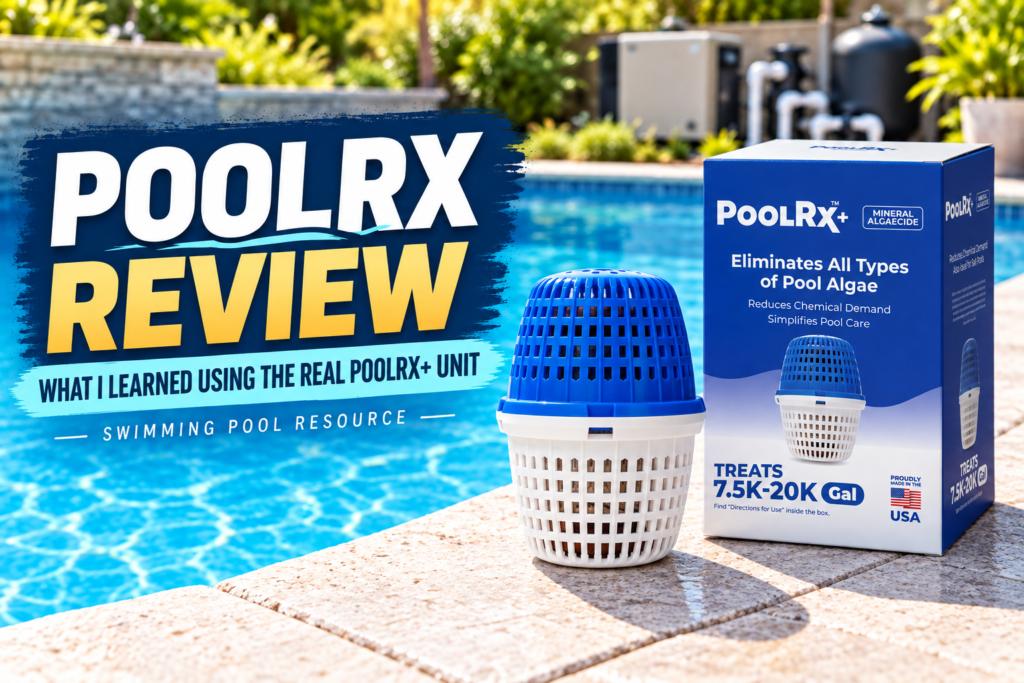
I used PoolRx across its size range while owning and operating a pool-service company in Northern California. That included spa and small-water units, the blue and black pool units, and booster minerals used on larger pools or during longer, harder seasons. The models are different sizes, but the lesson was consistent: PoolRx works best as a correctly sized algae-control partner to chlorine—not as a replacement for testing, circulation, filtration, or sanitation.
My PoolRx review in one sentence
My verdict: PoolRx can be worth the money for an algae-prone pool or an owner who wants a simpler maintenance routine, provided the unit is sized to the actual water volume, the filter and circulation are healthy, and a dependable chlorine residual is maintained.
I would not use it to cover up high stabilizer, poor circulation, a dirty filter, low sanitizer, or an unknown water-balance problem. It is a registered mineral algaecide, not a substitute for the fundamentals.
Best fit: A properly balanced chlorine or saltwater pool that repeatedly develops algae or consumes more chlorine than expected.
Biggest advantage: Ongoing algae suppression can make normal maintenance more forgiving and may reduce chemical demand.
Biggest limitation: It adds copper-based active ingredients to the water, must be sized carefully, and still requires chlorine and regular testing.
Buying rule: Choose by total gallons, not by color, package price, or the idea that “more must be better.”
Check current PoolRx options on Amazon (paid link)
PoolRx warns that lookalike products can appear in Amazon search results. Confirm that the listing is for genuine PoolRx, matches the required gallon range, and is sold by a trusted seller before ordering.
What PoolRx is—and what it is not
PoolRx is a mineral-based algaecide. The current PoolRx+ formula lists copper sulfate pentahydrate, zinc sulfate monohydrate, and silver nitrate as active ingredients. The minerals dissolve into the water and are intended to work alongside a constant chlorine residual.
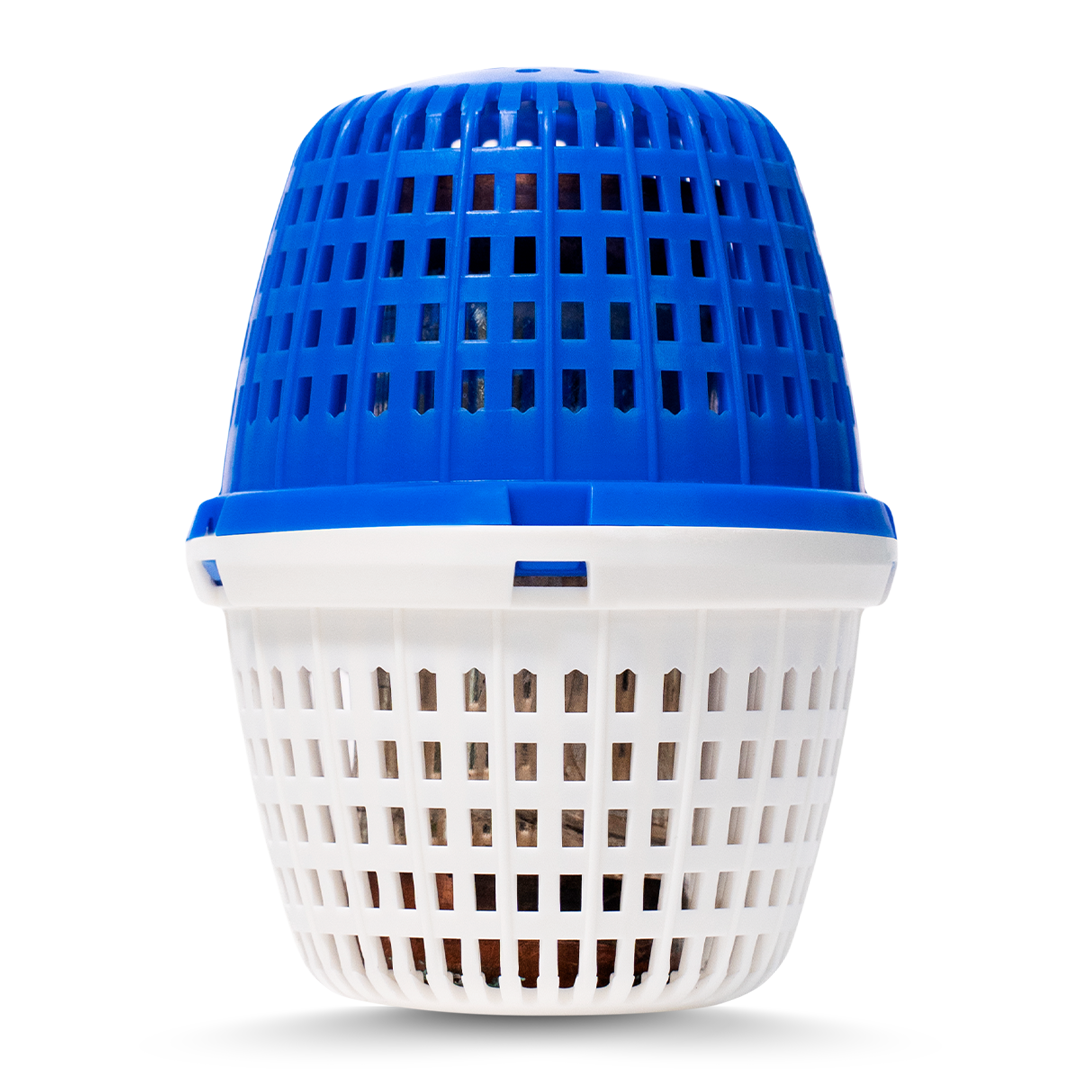
The unit’s cylinder remains in the skimmer or pump basket after the granular material dissolves. PoolRx says the circulating minerals pass over the cylinder and are rejuvenated during filtration. Minerals are gradually lost through algae kill, filter cleaning, backwashing, splash-out, and other water loss, which is why a booster may be needed later.
PoolRx is not a complete sanitizer system. It does not remove the need to:
- maintain an appropriate free-chlorine level;
- test pH, alkalinity, stabilizer, calcium, and other relevant chemistry;
- circulate and filter the water adequately;
- brush and remove debris;
- correct a clogged filter, air leak, closed valve, or undersized pump schedule; or
- follow local health requirements for a public or commercial pool.
The product label discusses a 0.5–1.0 ppm residential chlorine range with PoolRx under specified conditions. CDC’s general home-pool guidance recommends at least 1 ppm free chlorine without cyanuric acid and at least 2 ppm when cyanuric acid is used. Those numbers are not interchangeable universal recipes. Follow the registered product label, dependable test results, the needs of the actual pool, and any local code.
How the models compare
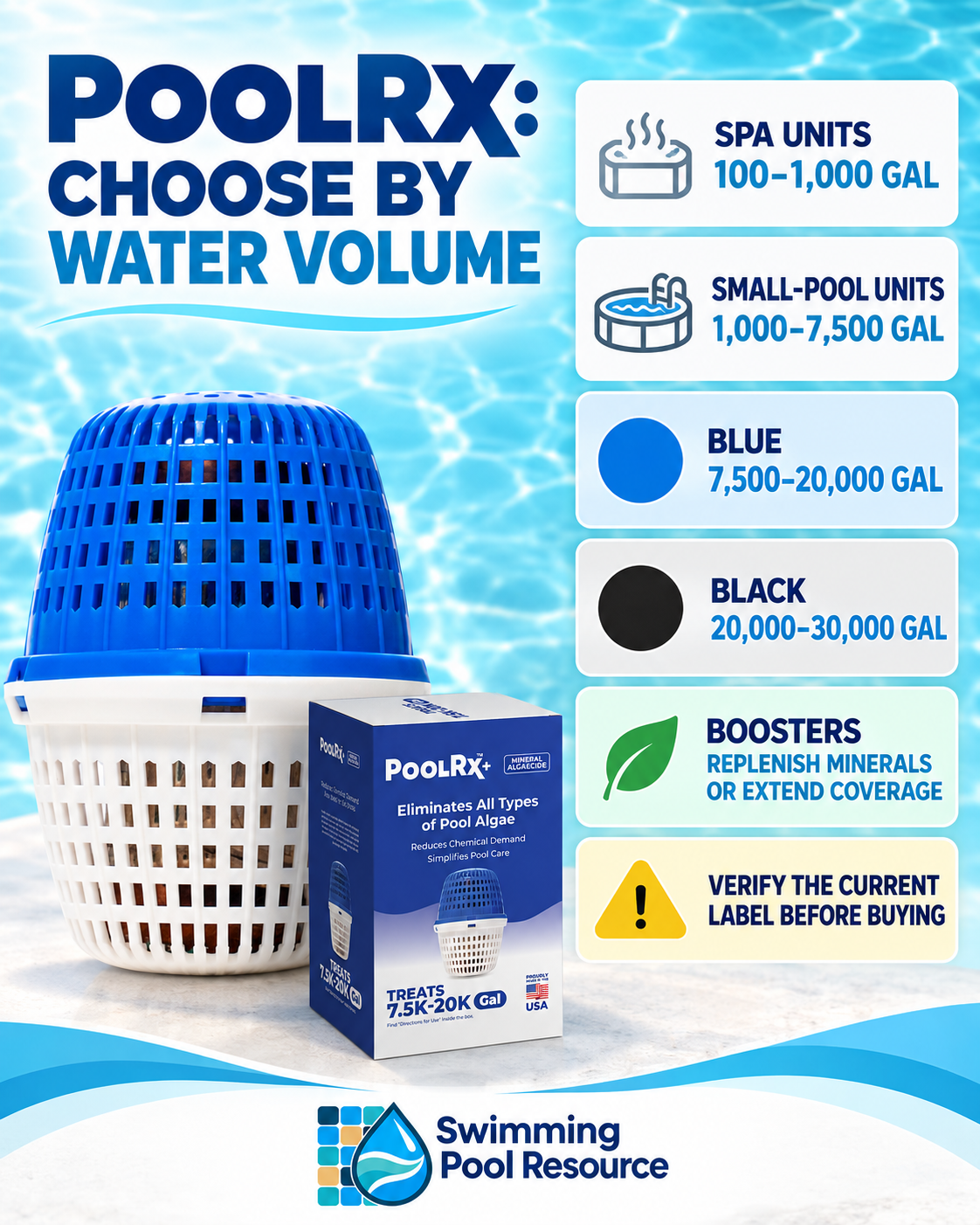
PoolRx has sold both an original copper-based formula and the newer PoolRx+ formula, which adds zinc and silver active ingredients. Product names, colors, bundles, and availability can change. The table below reflects the ranges currently shown on PoolRx’s official product and sizing pages; always verify the label on the unit you are buying.
| Model or combination | Published water range | Practical buying note |
|---|---|---|
| Yellow/White PoolRx+ | 100–400 gallons | Small spa or hot-tub range; not for a full-size pool |
| Purple/White PoolRx+ | 400–1,000 gallons | Larger spa or very small water volume |
| White Original | 1,000–2,500 gallons | Original-formula small-pool unit; availability may vary |
| Red/White PoolRx+ | 2,500–5,000 gallons | Small pool range |
| Orange/White PoolRx+ | 5,000–7,500 gallons | Mid-size above-ground or compact in-ground pool range |
| Blue Original or Blue/White PoolRx+ | 7,500–20,000 gallons | The common residential-pool size |
| Black Original or Black/White PoolRx+ | 20,000–30,000 gallons | Larger residential-pool size |
| Blue/White unit plus Blue/White booster | Up to 30,000–40,000 gallons when used together | The booster can also replenish a 7,500–20,000-gallon installation later |
| Black/White unit plus the specified booster | Up to 40,000–60,000 gallons, depending on the booster | Follow the official chart; the correct booster changes with total volume |
A booster is not automatically a complete starter treatment
A PoolRx booster replaces minerals lost from the water or extends the treatment capacity of a correctly planned installation. The current PoolRx+ label says the booster is used with a previously purchased PoolRx+ unit. It does not go back inside the cylinder.
Do not grab a booster only because it costs less than a complete unit. First determine whether the pool needs an initial unit, a replacement unit, or a booster under the current label.
Compare PoolRx booster listings on Amazon (paid link)
What I learned from using the different sizes
1. The color is only useful after you know the gallons
The blue and black units are easy to remember, but the color is not the decision. Pool volume is. A 21,000-gallon pool is not a “close enough” blue-unit pool just because the owner found a better price. Likewise, oversizing does not guarantee better results and can create unnecessary mineral concentration.
Before buying, calculate the actual pool volume rather than relying on a real-estate listing or a rough guess. Include connected spa water when it shares the same circulation system.
2. PoolRx cannot repair a circulation problem
The unit depends on water moving through the skimmer or pump basket and through the filter. If the pump loses prime, return flow is weak, valves are wrong, or the filter is restricted, minerals will not be distributed through the pool as intended.
When a pool stayed green because the system barely moved water, another chemical purchase was not the first answer. I would correct the mechanical problem, clean the pool, establish reliable circulation, and then judge the treatment.
Use the low-flow troubleshooting guide before blaming an algaecide for a circulation failure.
3. A clean filter at installation matters
PoolRx’s directions call for starting with a clean filter. That matches practical service experience: the filter needs capacity to catch dead algae and debris, and you do not want newly added minerals immediately discarded with dirty filter media.
Follow the current directions for your filter type. A cartridge, sand, and D.E. filter do not share an identical startup procedure. If you maintain cartridges, see how to clean a cartridge pool filter safely.
4. The best candidates are pools with real algae pressure
PoolRx makes the most sense when it solves a recurring problem. A sunny pool, warm water, a long season, heavy organic load, or persistent algae pressure can create a strong case for a supplemental registered algaecide.
On a pool that already stays clear with stable chemistry and modest chlorine demand, the savings may be less dramatic. I would not add it simply because every pool “should” have one. The product should earn its place in the maintenance plan.
5. Booster timing depends on conditions, not a perfect calendar date
PoolRx says minerals can be lost through algae kill, filter cleaning, backwashing, and splash-out. A hot, heavily used pool or a green-to-clear cleanup can consume the treatment sooner than a quiet, covered pool.
Increasing chlorine demand, returning algae, or dull water can be signs to investigate, but they do not automatically prove the minerals are depleted. Test the water and check circulation first. If those are correct, the current product directions can help determine whether a booster or replacement unit is appropriate.
6. Lower chemical demand does not mean “stop testing”
A clear-looking pool can still have inadequate sanitizer or an unfavorable pH. PoolRx may reduce algae pressure and make chlorine last longer, but appearance is not a disinfectant test.
Use a dependable drop-based kit and record trends. The accurate pool-water testing guide explains the routine I used to avoid treating the wrong problem.
PoolRx pros and cons
What I like
- Simple routine: Once the pool is prepared and the correct unit is installed, there is no daily PoolRx dosing step.
- Useful algae support: It can add a meaningful buffer against recurring algae in the right pool.
- Multiple water-volume options: The size range covers spas, small pools, common residential pools, and larger installations.
- Compatible system choices: PoolRx lists chlorine, salt, UV, and ozone systems among its intended applications.
- Booster option: Lost minerals can be replenished without buying another complete cylinder every time.
- Clear role: Used correctly, it can reduce the need for other specialty algaecides and reactive treatments.
What I would watch carefully
- It still needs chlorine: Mineral treatment is not permission to let sanitizer fall to zero.
- Copper is an active ingredient: Test for existing metals and use the product only as labeled, especially where staining or unusual source water is already a concern.
- Sizing errors matter: The wrong unit can under-treat or unnecessarily over-treat the water.
- Compatibility limits: PoolRx says not to use the product with bromine, biguanides, or other copper-based products.
- Cal-hypo needs special attention: Follow both labels. PoolRx specifically warns against adding granular cal-hypo directly to the pool without the required dilution procedure.
- Filter work can shorten useful life: Backwashing, filter cleaning, and water loss remove minerals.
- Amazon listings require scrutiny: Similar-looking products and third-party sellers can make authenticity harder to judge.
- It will not fix the cause of every green pool: High stabilizer, poor flow, debris, inadequate filtration, or neglected brushing still need direct correction.
Could PoolRx stain a pool?
The PoolRx+ formula uses copper as its largest active ingredient. PoolRx says its minerals are chelated and that the process is intended to reduce staining concerns. The label nevertheless directs users to test for metals such as copper or iron before installation and provides additional instructions when levels are above 0.2 ppm.
My practical approach is conservative: know the starting water, size the unit correctly, avoid stacking it with other copper products, keep pH controlled, and do not improvise beyond the label. If a pool already has unexplained stains, colored water, known metal-rich fill water, or a previous copper treatment, diagnose that condition before adding more metal-based product.
Use the pool-problem finder if you are unsure whether the color is algae, suspended metal, scale, or another issue.
Does PoolRx work with a saltwater pool?
PoolRx lists its pool products as suitable for saltwater chlorine systems. The mineral unit does not replace the salt cell; it works with the chlorine that the cell produces. Owners still need to test free chlorine and pH, inspect the cell, maintain salt in the manufacturer’s range, and confirm adequate pump runtime.
If chlorine demand decreases, adjust output carefully from test results rather than making a large one-time reduction. A saltwater pool can look clear while sanitizer quietly falls below the target.
Who should consider PoolRx?
It may be a good fit if you:
- repeatedly fight algae despite correcting water balance and circulation;
- maintain a sunny, warm, or long-season pool with high algae pressure;
- want a low-touch supplemental algaecide rather than frequent reactive products;
- can calculate the water volume accurately;
- will continue testing and maintaining chlorine; and
- are willing to confirm product compatibility before installation.
Who should skip it—or fix something else first?
I would pause before buying if you:
- use bromine or a biguanide sanitizer;
- already use another copper-based product;
- have unexplained metal staining or high copper/iron readings;
- do not know the pool volume;
- are trying to compensate for weak flow, a dirty filter, or a pump problem;
- have very high cyanuric acid and are simply adding more products instead of correcting it; or
- expect PoolRx to replace chlorine, testing, brushing, and filtration.
How to buy the right PoolRx on Amazon
Amazon availability and sellers change, so this review does not display a fixed price or promise that the first result is genuine. Use this checklist:
- Calculate the total water volume.
- Match the range to PoolRx’s current official sizing chart.
- Confirm whether the listing is Original PoolRx or PoolRx+.
- Verify the exact unit, booster, bundle, and quantity.
- Check the seller, product photos, label, return policy, and recent listing details.
- Avoid sponsored lookalikes that use similar colors or vague “replacement” wording.
- Recheck the delivered label before putting anything in the water.
Shop PoolRx Blue/White options on Amazon (paid link)
Shop PoolRx Black/White options on Amazon (paid link)
Shop PoolRx spa-unit options on Amazon (paid link)
Frequently asked questions
Does PoolRx replace chlorine?
No. PoolRx is intended to work with a maintained chlorine residual. Follow the registered label, test the water routinely, and meet any applicable public-health or local requirements.
How long does PoolRx last?
PoolRx describes effectiveness for up to six months for many current units, while treatment life varies with algae load, backwashing, filter cleaning, splash-out, and other conditions. Some current directions also recommend a new unit each year and a booster after four to six months when needed. Use the label supplied with the exact product.
Is the blue unit weaker than the black unit?
The colors primarily identify different water-volume ranges. The black pool unit is intended for a larger volume than the blue unit; that does not make it the better choice for a smaller pool. Correct concentration matters more than buying the largest cartridge.
Can I use a booster by itself?
The current PoolRx+ booster directions describe it as replenishment used with a previously purchased PoolRx+ unit or as part of a planned larger-pool installation. Do not assume the booster is a cheaper replacement for the initial unit.
Can I use PoolRx with bromine?
PoolRx says its minerals are not compatible with bromine or biguanides. Choose a treatment designed for the sanitizer system you actually use.
Can PoolRx clear a green pool?
The manufacturer says its minerals can help clear algae, but a green pool still needs correct diagnosis, adequate circulation and filtration, dependable testing, brushing and debris removal, and sanitizer maintained according to the label. Green water caused by metals or poor circulation will not be solved by treating every case as algae.
Is PoolRx worth it for every pool?
No product is worth adding without a reason. PoolRx is easiest to justify when it reduces a recurring algae-control burden. If a pool is already consistently clear with modest chemical use, the financial benefit may be smaller.
My bottom line
After using the different PoolRx sizes and boosters in real service work, I see the product as a useful specialist—not a shortcut around pool care. Correctly sized PoolRx can reduce algae pressure and make a chlorine-based maintenance routine easier. Its value is strongest on the pools that genuinely need that extra layer of control.
The non-negotiables remain the same: know the gallons, start with a clean filter, maintain circulation, test the water, keep an appropriate sanitizer residual, and follow the exact label. If the pool is green because the pump is not moving water or the stabilizer is severely out of range, correct that problem instead of asking an algaecide to hide it.
Check current genuine PoolRx listings on Amazon (paid link)
Chris Barnes is a former Northern California pool-service company owner with more than seven years of residential and commercial experience. Swimming Pool Resource turns field experience and current manufacturer guidance into practical steps homeowners can use to troubleshoot, service, and maintain their pools.
Need help choosing a size or deciding whether PoolRx fits your pool? Ask Chris about your pool and include the total gallons, surface type, sanitizer, current test results, filter type, and a description of the algae or chlorine-demand problem.