
How to Test Pool Water Accurately: 7 Essential Steps
Learning how to test pool water accurately starts with a representative sample, a dependable kit, and the same careful routine every time. These seven field-tested steps help you avoid treating the wrong problem.
How to Test Pool Water Accurately: Quick Answer
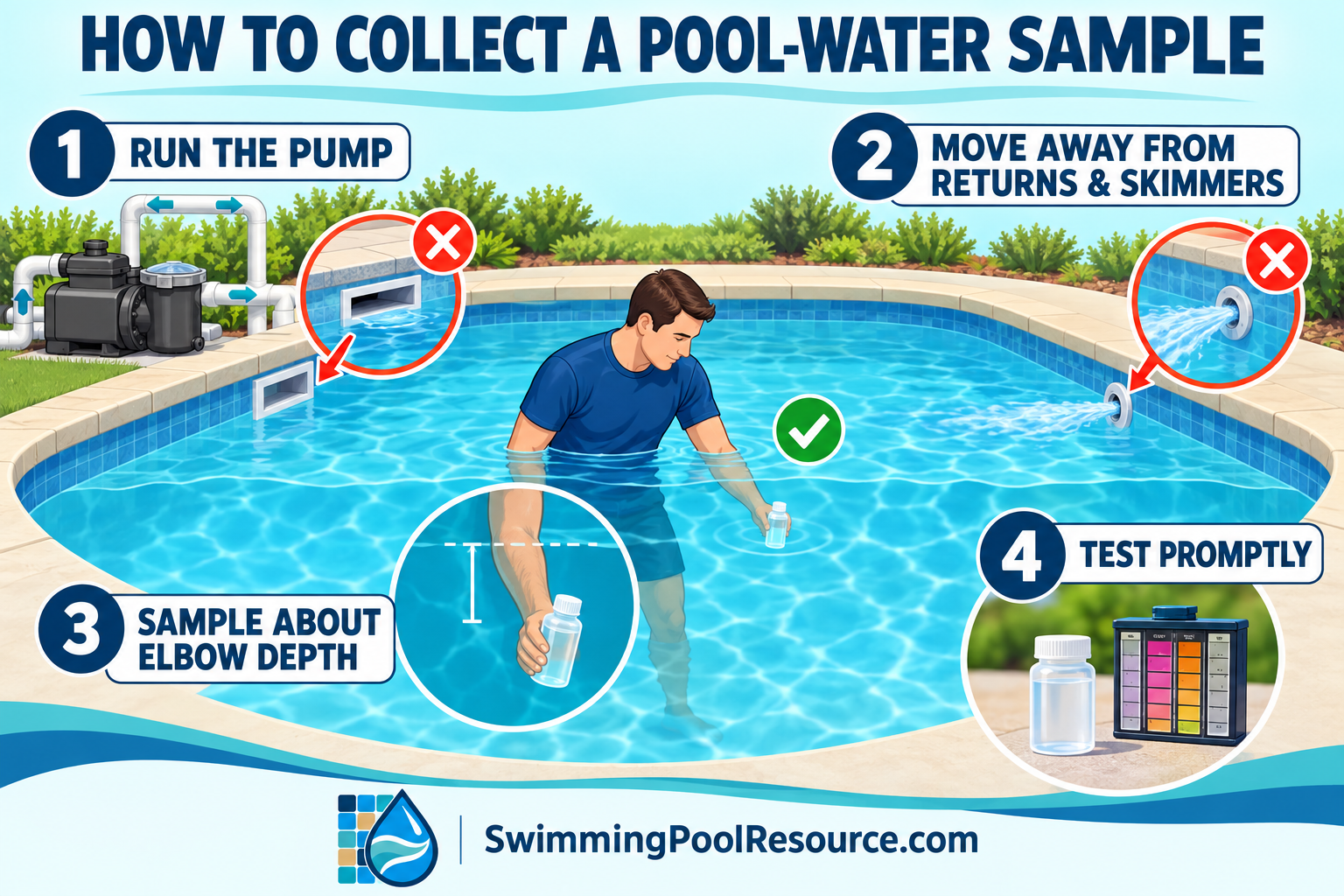
Here is how to test pool water accurately: circulate the pool first, collect a fresh sample away from returns and skimmers at about elbow depth, measure the exact volume your kit requires, keep every reagent drop consistent, and record the result before adding chemicals. Retest any surprising number before you dose the pool.
Use representative water
Collect away from returns, skimmers, steps and other spots where circulation can distort the reading.
Follow your kit exactly
Use the correct fill line, reagent, drop count and endpoint for that specific manufacturer and test.
Retest surprises
A strange result deserves a second test. One bad reading can lead to an expensive chain of unnecessary corrections.
Equipment You Need to Test Pool Water Accurately
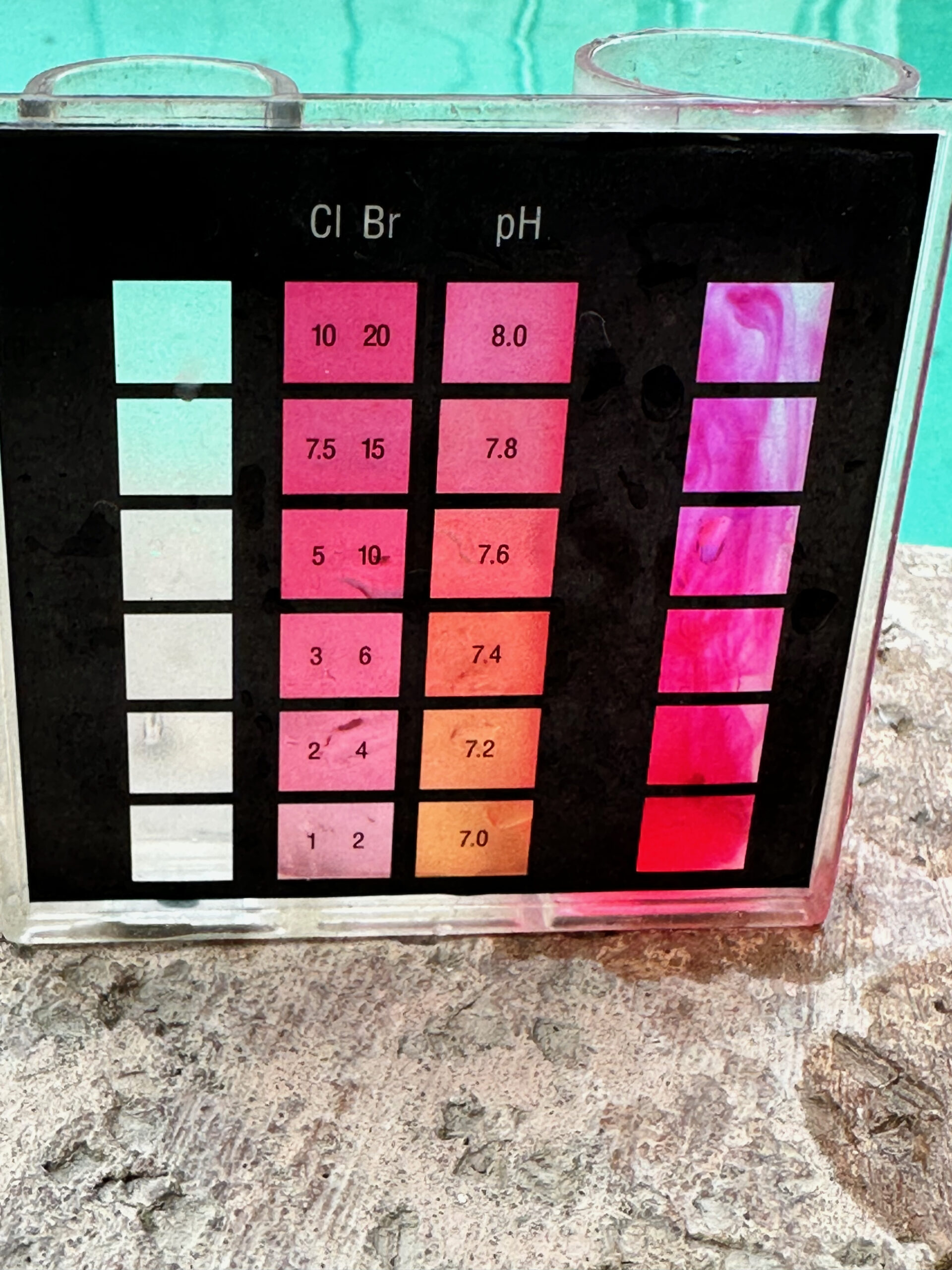
For routine home-pool care, the most reliable way to understand how to test pool water accurately is to use a complete drop-based kit that can measure free and combined chlorine, pH, total alkalinity, calcium hardness and cyanuric acid (CYA). CDC says a DPD method is more accurate for chlorine and pH than test strips. A FAS-DPD chlorine test, such as the one in the Taylor K-2006, also gives a clear color-change endpoint and is useful when you want more precision.
- A clean test cell or plastic sample bottle
- Fresh, correctly stored reagents
- Your kit’s current instructions and conversion factors
- Natural daylight for color comparisons
- A simple testing log—paper or digital
See my Taylor K-2006 test-kit review →
One common mistake I saw homeowners make was relying on test strips that had been sitting in the sun for several seasons and expecting an accurate reading. Test strips can be useful as a quick screening tool, but heat, moisture, age, and poor storage can produce misleading results. On my service route, I treated strips as a rough guide and confirmed important decisions with a quality drop-reagent kit. I often recommended a complete kit such as the Taylor K-2105. Reliable numbers can prevent unnecessary chemical treatments, protect equipment, and save a pool owner a substantial amount of money—yet accurate testing is still one of the most overlooked parts of pool care.
How to Test Pool Water Accurately in 7 Essential Steps
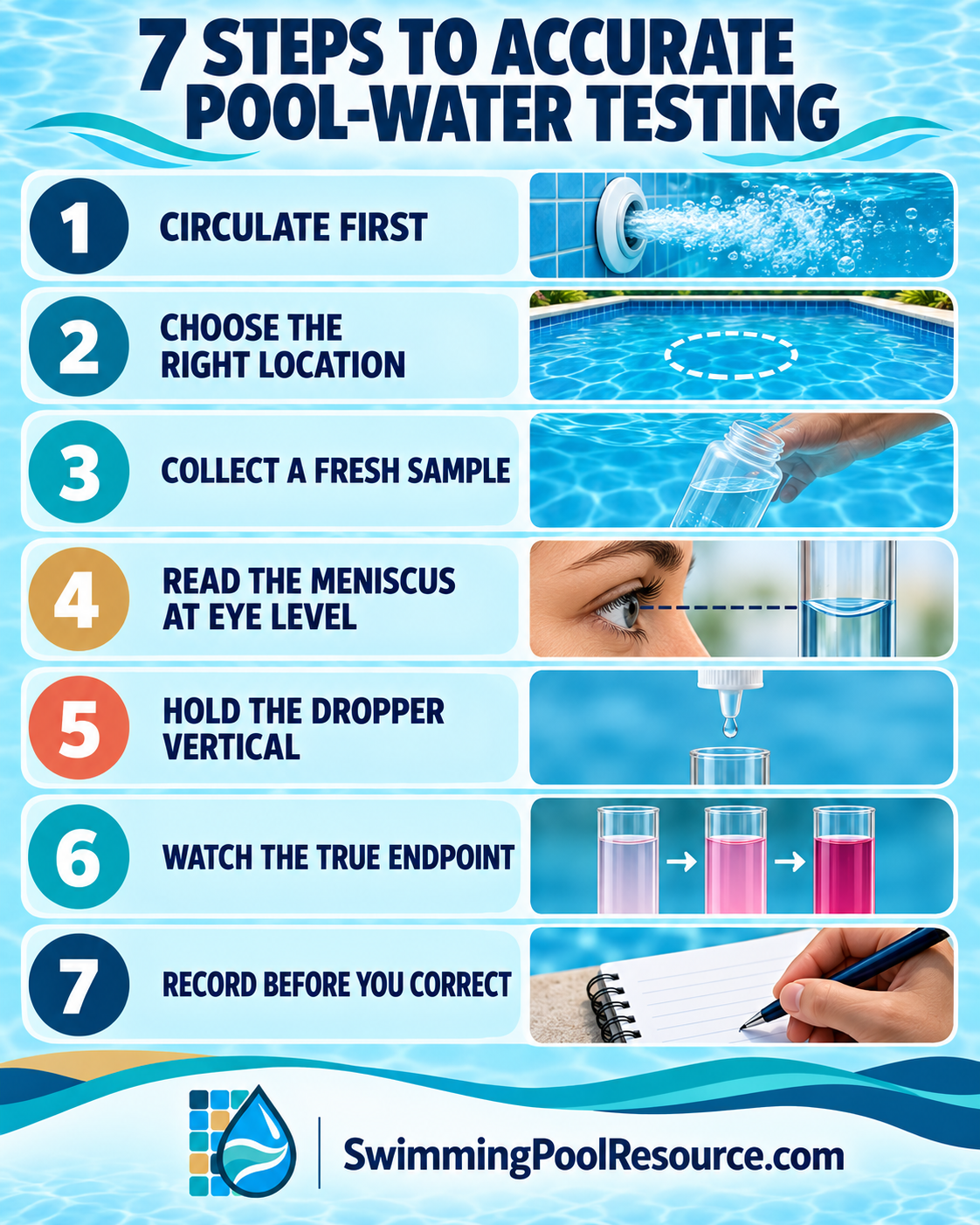
Use this same order every time. Consistent circulation, sampling, measuring, drop technique, endpoints, and recordkeeping are what turn a test-kit reading into a decision you can trust. That consistency is the foundation of how to test pool water accurately.
Circulate the pool first
Test while the pump is running and the water has had time to mix. Do not pull a sample from a stagnant corner or immediately after adding a chemical. Follow the treatment label for its required circulation and retest time; Taylor notes that some treatment checks may require two filtration cycles before retesting.
Choose the right sampling location
Move away from return jets, the skimmer, steps, ledges and dead zones. Taylor recommends a representative location toward the middle of the pool and about elbow depth—roughly 18 inches below the surface.
Collect a fresh sample
Rinse the clean plastic sample container with pool water. Submerge it upside down, turn it upright at the target depth, fill it, and test promptly. Sanitizer readings can change when a sample sits exposed to air.
Read the meniscus at eye level
The surface of water in a narrow tube curves. Hold the tube at eye level and place the bottom of that curve on the required fill line. A small volume error can change a drop-count result.
Keep every reagent drop uniform
Hold the dropper bottle straight up and down, not at an angle, and do not let its tip touch the test cell or your fingers. Swirl or invert only as your instructions specify. Never mix caps or reagents from different manufacturers.
Watch for the true endpoint
For a titration, count each drop until the instructed permanent color change. If you are unsure the endpoint is complete, add one more drop; if the color does not change further, do not count that confirming drop.
Record before you correct
Write down the date, time, water temperature, free chlorine, combined chlorine, pH, total alkalinity, calcium hardness and CYA. Add notes about heavy swimming, rain, chemical additions and anything unusual at the pump or filter.
Pool-Water Test Results: What Each Number Means
| Test | What it reveals | Why it matters |
|---|---|---|
| Free chlorine (FC) | Sanitizer available to work | Too little reduces germ control; an unexpectedly high sample can bleach some color tests and appear falsely low. |
| Combined chlorine (CC) | Chlorine already bound to contaminants | Helps explain odor, irritation and sanitizer demand when interpreted with the rest of the water picture. Persistent demand may point to why a pool keeps losing chlorine. |
| pH | How acidic or basic the water is | Affects swimmer comfort, equipment protection and how effectively chlorine works. |
| Total alkalinity (TA) | The water’s buffering capacity | Helps explain why pH is stable, drifting or difficult to control. |
| Calcium hardness (CH) | Dissolved calcium level | Part of the scale-versus-corrosion balance, especially important for plaster and cement-based surfaces. |
| Cyanuric acid (CYA) | Chlorine stabilizer level | Changes how sunlight affects chlorine and how sanitizer readings should be interpreted. If it is elevated, see how to lower high cyanuric acid. |
8 Mistakes That Distort Pool-Water Test Results
If you are learning how to test pool water accurately, eliminate these technique and storage errors before assuming the chemistry itself is unusual.
Testing at a return jet
The sample may reflect freshly treated water instead of the whole pool.
Guessing at the fill line
Read the bottom of the meniscus at eye level and use the volume in the instructions.
Tilting the reagent bottle
Angled bottles produce inconsistent drops and can change a titration result.
Using old or heat-damaged reagents
Heat, freezing, sunlight, moisture and time all reduce reliability. Inspect the kit each season.
Mixing brands or caps
Similar names do not mean equal reagent strength. Keep each cap and reagent with its own kit.
Matching color in poor light
Use natural daylight with the sun behind or over your shoulder; avoid sunglasses and colored indoor light.
Waiting too long to read
Unless the instructions specify a wait, compare the result promptly because some reactions keep changing.
Dosing from one strange result
Rinse the cell, collect a new sample and repeat the test before making a large adjustment.
How Often Should You Test Pool Water?
Knowing how to test pool water accurately is only useful when the schedule matches conditions. CDC advises home pool and hot-tub owners to test disinfectant and pH at least twice per day—and more often with heavy use. Commercial pools are governed by local codes and may require more frequent testing and formal logs.
Test again when conditions change
- After heavy swimming, a storm, a large water addition, or unusually hot weather
- After a chemical treatment, once the label’s circulation and waiting instructions are met
- When water turns cloudy or green, or chlorine use suddenly increases
- When pH keeps drifting or you see scale, staining or surface deterioration
- Before reopening a pool after an equipment or circulation problem
Never combine reagents or pool-treatment chemicals, never return used test solutions to the pool, and keep the kit away from children and pets. Follow every product label. For suspected exposure, electrical or gas-equipment problems, or water so cloudy the main drain is not clearly visible, keep swimmers out and get qualified help.
Pool-Water Testing FAQs
These answers cover the timing and technique questions that most often cause conflicting readings.
What order should I test pool water?
Use the order in your kit instructions. For a full routine, first collect one representative sample, then test free and combined chlorine, pH, total alkalinity, calcium hardness, and cyanuric acid. Record every result before making corrections so one chemical addition does not affect the next reading.
How long after adding chemicals should I retest?
Follow the product label because the required circulation time varies by chemical and dose. Keep swimmers out for the stated waiting period, run the circulation system as directed, and collect a new sample only after the treatment has mixed. Some checks may require up to two filtration cycles.
Are pool test strips accurate enough?
Strips are useful for a quick screening check when they are fresh, dry, and stored correctly. For important dosing decisions, a complete drop-based kit generally provides more repeatable chlorine, pH, alkalinity, hardness, and CYA results.
Why do two pool-water tests give different results?
Different sample locations, water volumes, lighting, reagent age, drop angle, endpoint judgment, or time between sampling and reading can change a result. Rinse the cell, collect a fresh representative sample, repeat the manufacturer’s method exactly, and compare again.
Should I test pool water at the surface or below it?
Collect below the surface—about elbow depth or roughly 18 inches—in a well-circulated area away from returns, skimmers, steps, and dead zones. That location is more representative of the pool as a whole and is central to how to test pool water accurately.
Have a result that does not make sense?
Send Chris the readings, pool type and what changed. A clean diagnosis should come before another chemical purchase.
Written and field-reviewed by Chris Barnes. Former Northern California pool-service company owner with more than seven years of residential and commercial pool experience. Last reviewed September 9, 2026.