
By Chris Barnes · Former pool-service company owner · 7+ years of residential and commercial experience
Pool pump keeps losing prime? Repriming may restart circulation, but it does not correct the condition that allowed air into the suction side or water to drain out. Begin with the pool water level and skimmer, then inspect the pump lid, O-ring, drain plugs, unions, baskets, and valve positions. The timing of the failure—during operation, immediately after shutdown, overnight, or only on one suction line—often points to the cause.
Safety first: Stop the pump, disconnect power at the breaker, and relieve filter pressure before opening the pump lid or touching equipment. Never run a pump dry, move a multiport valve while the pump is running, open a pressurized filter, use an open flame to find an air leak, or force compressed air or chemicals into pool plumbing. Follow the manuals for your exact pump and filter.
Pool Pump Keeps Losing Prime? The Quick Answer
If your pool pump keeps losing prime, look for a place where air can enter before the impeller or water can drain backward after shutdown. Correct low pool water, a skimmer vortex, a stuck weir, full baskets, and an incorrect valve position first. With power disconnected and pressure relieved, clean the pump-lid sealing surfaces, inspect the O-ring, and check accessible drain plugs and suction unions.
After each correction, use the safe pool-pump priming procedure for your installation. Watch the clear lid, pool returns, and filter gauge at the same pump speed. If the pot repeatedly drains, return bubbles continue, one suction line behaves differently, or the problem returns after every shutdown, stop reprime-and-run cycles and find the underlying fault.
What “Losing Prime” Actually Means
A primed pump has enough water in its strainer housing and suction line to move water continuously. A small stable air pocket under some clear lids can be normal at a low variable-speed setting. A pump that repeatedly gulps air, loses most of the water under the lid, spits large bursts of air from the returns, or cannot build its normal filter pressure has not maintained prime.
Most recurring prime problems are on the suction side: the path from the pool through the skimmer or drain, valves, piping, lid, and pump inlet. While the pump runs, that portion can be under vacuum. A connection may draw air without leaking much water outward, which is why a dry equipment pad does not rule out a suction leak.
What the Timing of Prime Loss Tells You
When a pool pump keeps losing prime, the timing of the failure is one of the strongest diagnostic clues.
| When it happens | Likely direction | Best first check |
|---|---|---|
| The pot drains within seconds of startup | Low water, skimmer vortex, closed suction valve, severe restriction, or major suction leak | Stop the pump; check water level, skimmer, baskets, and valve positions |
| Air slowly increases while running | Pump-lid seal, drain plug, union, valve stem, or suction-plumbing leak | Inspect the visible suction side at the same operating speed |
| It primes at low speed but pulls air at high speed | Low water or a small suction leak exposed by stronger vacuum | Watch the skimmer and pump lid as speed changes |
| It stays primed while running but drains after shutdown | Lid or fitting leak, valve leakage, or water draining back through the suction path | Document the water level under the lid immediately after shutdown and later |
| Only one skimmer or suction mode causes the problem | Local weir, basket, valve, plumbing, or blockage issue | Compare lines one at a time without closing every suction path |
| The problem began after basket or equipment service | Mis-seated lid, dirty O-ring, loose drain plug, or changed valve position | Return the system to its documented normal setup |
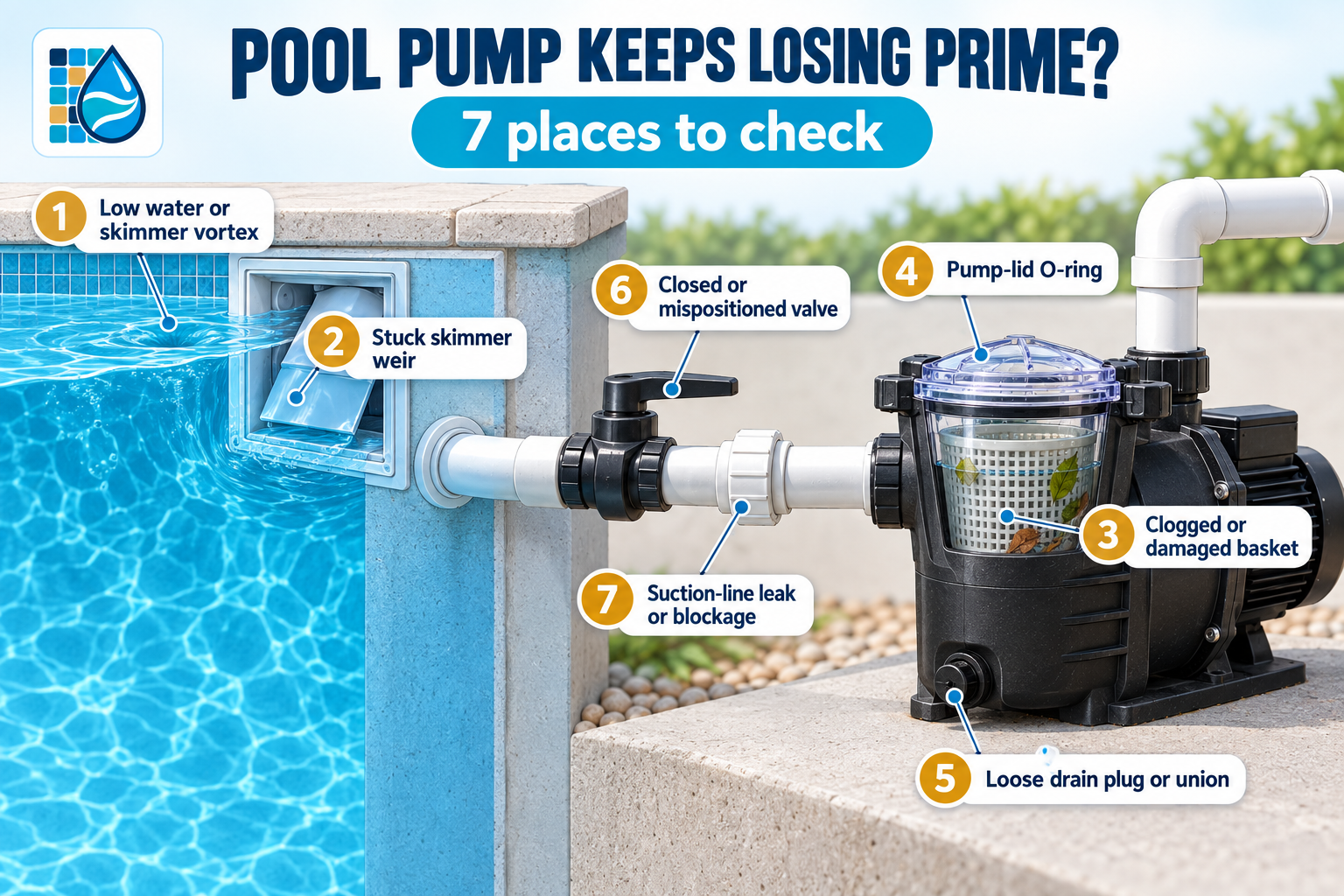
7 Safe Checks When a Pool Pump Keeps Losing Prime
Use this sequence when a pool pump keeps losing prime so you can move from simple water-supply checks to less visible suction-side faults.
1. Correct the Pool Water Level and Skimmer Vortex
Water near the middle of the skimmer opening is a useful starting point for many residential skimmers, but your installed model’s manual controls. If the level is low, the skimmer can form a vortex and pull air. A stuck weir door, a floating toy, or debris at the opening can create the same pattern even when the pool does not look very low.
Watch the skimmer briefly from a safe distance at the normal pump speed. Gurgling, a funnel in the water, or a weir that stays closed deserves attention before you open equipment. Use the pool-skimmer troubleshooting guide for a line-specific check.
2. Empty Both Baskets and Inspect the Pump Lid
Turn the pump off and disconnect power. Relieve pressure as the filter manual directs. Empty the skimmer and pump baskets, then look for splits, missing sections, or a basket that no longer seats correctly. A packed basket restricts water; a broken basket lets debris travel toward the impeller or suction line.
Clean the pump-lid groove and mating surface. Inspect the O-ring for flattening, cracks, swelling, debris, or a twist. Reinstall it only as the pump manufacturer directs; use only an approved lubricant when the manual permits it. Align and hand-tighten the lid rather than forcing it with a tool.
3. Check Drain Plugs, Suction Unions, and Valve Stems
A loose pump drain plug, hardened plug O-ring, suction union, or worn valve seal can admit air. Inspect only accessible components with the equipment safely off. Look for a missing O-ring, cracked fitting, cross-threaded plug, or a union that was disturbed during recent work.
Do not keep tightening a plastic fitting that already appears damaged. Excess force can crack a housing or union. Electrical work, pump disassembly, glued-plumbing repair, and replacement of a damaged housing belong with a qualified professional.
4. Return Suction Valves to Their Normal Positions
A valve left closed or partly closed can starve the pump. Compare the handles with a labeled photo of normal operation. Pool/spa combinations, cleaners, water features, and automation can change the suction path, so note whether the problem begins in one mode.
Never position the system so every suction or return path is closed. Stop the pump before moving a multiport filter valve. If a valve handle turns without changing flow, leaks at the stem, or no longer matches the internal diverter, the valve may need service.
5. Separate an Air Leak From a Flow Restriction
When a pool pump keeps losing prime, both air leaks and restrictions deserve attention because they can create low pressure and weak returns, but the clues differ. Persistent bubbles under the lid and at the returns point toward air entering before the pump. A full basket, plugged skimmer, obstructed suction line, or clogged impeller can limit water without producing the same continuing stream of bubbles.
Homeowners can remove visible debris from accessible baskets with the system off. Do not reach into the pump, probe the impeller through an opening, or force a suspected plumbing blockage. A professional can isolate the line and determine whether the restriction is in the skimmer, valve, pipe, diffuser, or impeller.
6. Compare Shutdown Drain-Back With Running Air
If the pump remains full while running but empties only after shutdown, photograph the water level under the clear lid immediately and again later. Drain-back can occur through a lid seal, drain plug, union, valve, or suction line. Some installations use check valves, especially with elevated equipment or rooftop solar, but adding one is not a substitute for repairing a leak.
A check valve also will not correct air that enters while the pump is running. Do not install parts based only on an overnight symptom; confirm the plumbing layout and follow the equipment designer’s or manufacturer’s requirements.
7. Inspect Exposed Suction Plumbing and Escalate Hidden Leaks
With the system off, visually inspect exposed PVC, unions, valve bodies, the pump housing, and supports. Look for cracks, movement, staining, or a fitting placed under mechanical stress. A pump that shifts on its pad or unsupported piping can strain connections.
If the visible checks do not explain why the pool pump keeps losing prime, the remaining possibilities include a concealed suction leak, cracked skimmer body, failing underground fitting, internal pump damage, or a line blockage. Those faults require appropriate testing and repair—not guesswork or excessive pressure.
Use Filter Pressure as a Clue, Not a Verdict
Compare pressure only at the same pump speed and normal valve configuration. Your clean-filter baseline is more useful than a universal number.
- Unusually low pressure with visible air: inadequate water reaching the pump, a suction leak, low water, wrong valve position, or an intake restriction.
- Unusually low pressure without obvious air: low programmed speed, a blocked basket or impeller, valve position, gauge error, or pump problem.
- Higher-than-normal pressure with weak returns: a restriction after the pump, often at the filter or return side—not a classic prime-loss diagnosis.
Use the pool-filter guide to establish a repeatable clean baseline, and the pool-pump guide for the wider circulation path.
From Chris’s Service Route: The Leak Was Above the Equipment Pad
When a pool pump keeps losing prime only in one operating mode, trace that active path first. One recurring prime problem involved a pool with rooftop solar heating. The pump and plumbing at the equipment pad initially looked normal, but air returned whenever water moved through the solar circuit. Heat, ultraviolet exposure, and repeated expansion had stressed exposed roof plumbing, allowing the elevated loop to admit air and drain back.
The useful lesson was the timing. The pump did not lose prime in every mode; the behavior changed when the solar path operated. Recording which valves and features are active can separate a pump problem from a leak elsewhere in the connected system.
What Not to Do When a Pool Pump Loses Prime
- Do not let the pump repeatedly run dry while you watch for improvement.
- Do not loosen a lid, union, filter clamp, or gauge while equipment is running or pressurized.
- Do not use flame, smoke, solvent, drain cleaner, acid, chlorine, or another chemical to test or clear a suction line.
- Do not pressure-seal a garden hose or use compressed air in unknown pool plumbing.
- Do not bypass a safety interlock or work inside an electrical compartment.
- Do not assume a new pump will fix low water, a valve problem, an air leak, or a blocked line.
When to Call a Pool Professional
If your pool pump keeps losing prime after the visible checks, get qualified help. Professional service is also warranted when the pump will not establish prime, loses prime every cycle, has a cracked or warped lid or housing, leaks near the motor, trips the breaker, smells burned, overheats, or makes severe grinding or screeching sounds. Shut the system down for exposed wiring, flooding near electrical equipment, a damaged suction fitting, or a filter that leaks or fails to vent correctly.
Before the visit, record the pump model, speed, normal and current filter pressure, water level, valve positions, when the pot drains, which features are active, and whether bubbles appear at the returns. A short video of the clear lid during startup and shutdown can make the pattern easier to diagnose.
Pool Pump Losing Prime: Common Questions
Why does my pool pump lose prime overnight?
Water may be draining backward through a lid seal, drain plug, union, valve, suction line, or another connected path after shutdown. Document how quickly the pot empties. A check valve may be appropriate in some elevated systems, but it should not be used to hide an air or water leak.
Why does the pump lose prime only at high speed?
Higher speed creates stronger suction. That can expose a low-water skimmer vortex, small lid or fitting leak, restricted suction path, or plumbing limitation that is less obvious at low speed. Stop the pump if the pot drains or the system cannot maintain steady water flow.
Can a dirty filter make a pump lose prime?
A dirty filter usually creates resistance after the pump and raises pressure relative to the clean baseline. It can reduce circulation, but recurring air in the pump pot more often directs attention to the suction side. Read pressure, air, and return flow together. That distinction matters when a pool pump keeps losing prime.
Can a bad pump-lid O-ring cause prime loss?
Yes. A dirty, flattened, cracked, twisted, or incorrectly installed O-ring can admit air while the pump runs or allow water to drain after shutdown. Clean and inspect the sealing surfaces with power disconnected, then follow the exact pump manual for replacement and lubrication.
Is a little air under the clear pump lid normal?
A small stable pocket may occur on some pumps at low variable-speed settings. Expanding air, a pot that repeatedly empties, large return bubbles, gurgling, or failure to build the normal pressure and flow is not a stable condition.
The Bottom Line
When a pool pump keeps losing prime, do not treat repriming as the repair. Use the timing of the failure, then check water level, the skimmer, baskets, the lid and O-ring, accessible plugs and unions, valves, and exposed suction plumbing. Compare air, return flow, and filter pressure at the same setting. Stop before electrical work, pump disassembly, hidden plumbing, or forceful line-clearing methods.
Sources and Review Notes
Written and field-reviewed by Chris Barnes. Former Northern California pool-service company owner with more than seven years of residential and commercial experience. Last reviewed September 9, 2026. Equipment manuals, product labels, building requirements, and applicable local rules take priority.