
Wondering how long to run a pool pump? The short answer: six hours per day is a useful starting test for many clear, lightly used residential pools—but it is not a rule. The right schedule is the shortest one that consistently maintains clear water, steady sanitizer, effective skimming, and the flow required by connected equipment.
A single-speed pump may do its work in a shorter high-flow window. A variable-speed pump often runs longer at a lower speed because slower filtration can move the needed water with much less energy. Weather, swimmer load, leaves, water temperature, plumbing resistance, filter condition, and salt-chlorine production can all change the answer.
This guide gives you a safe way to set a baseline, measure the result, and adjust without guessing.
Quick starting schedule
Use these as field-tested starting ranges, not universal requirements. Follow the pump, filter, heater, sanitizer, and automation manuals when they specify a minimum flow or operating sequence.
| Pool condition | Practical starting point | What to watch |
|---|---|---|
| Cool weather, light use, little debris | 4–6 hours daily | Chlorine residual, clarity, surface debris |
| Warm weather and normal family use | 6–8 hours daily | Daily sanitizer demand and skimming |
| Hot weather, heavy use, wind, or falling leaves | 8–12 hours daily | Faster chlorine loss, debris, cloudiness |
| Variable-speed filtration | Longer at a low effective speed | Stable flow, salt-cell status, clean water |
| Active algae or cloudy-water recovery | Follow the verified treatment plan | Filter loading, pressure, sanitizer, visibility |
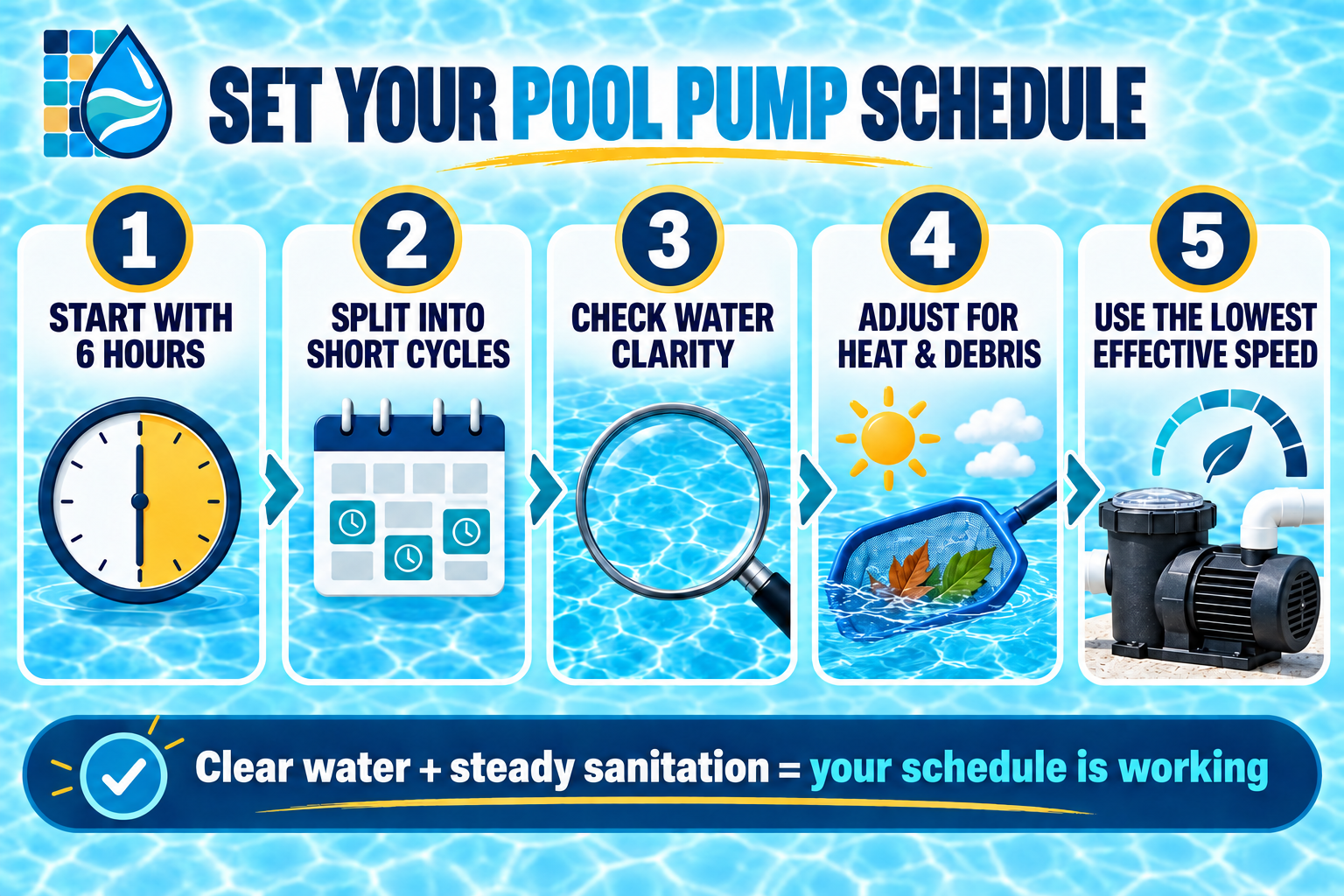
If six hours keeps the water clear and the sanitizer stable, try reducing the schedule in small steps. If the pool becomes dull, the skimmer falls behind, the salt cell cannot maintain chlorine, or returns weaken, correct the cause and add runtime only when the evidence supports it.
What the pump must accomplish each day
Pump runtime is not just about “turning over” a number of gallons. The circulation system has several jobs:
- Move suspended material to the filter.
- Pull floating debris toward the skimmer.
- Mix sanitizer and balance chemicals through the pool.
- Supply the flow required by a salt cell, heater, cleaner, or water feature.
- Reduce stagnant areas by sending treated water through the returns.
The CDC’s residential pool guidance emphasizes regular chlorine and pH testing because circulation cannot make up for an inadequate sanitizer level or incorrect pH. A longer schedule does not fix algae, a dirty filter, a blocked basket, a suction leak, or poor water balance.
Calculate one theoretical turnover
The calculation below helps estimate how long to run a pool pump for one theoretical turnover. A turnover is the time required to move a volume of water equal to the pool’s capacity through the circulation system. Use this formula:
Turnover hours = pool volume in gallons ÷ actual flow in GPM ÷ 60
Example for a 15,000-gallon pool with 40 gallons per minute of measured flow:
15,000 ÷ 40 ÷ 60 = 6.25 hours
That is a theoretical turnover—not a promise that every gallon has passed through the filter exactly once. Pool water mixes continuously, and some water can recirculate sooner than water in a low-flow area.
Actual flow matters. Do not use the maximum flow printed on a pump as though the plumbing always delivers it. Pipe size, valve positions, elevation, filter loading, heater resistance, pump speed, and the rest of the equipment pad affect real flow. A properly installed flow meter is the clearest measurement. If you do not have one, use the pool’s appearance, test results, equipment status, and clean-filter baseline to tune the schedule.
How long to run a pool pump: single-speed vs. variable-speed
Single-speed pumps
A single-speed pump runs at one relatively high speed. The main way to reduce energy use is to reduce unnecessary hours while still meeting the pool’s needs. Start with a reasonable daily window, then shorten or lengthen it in 30- to 60-minute steps while watching the water and equipment.
Variable-speed pumps
A variable-speed pump can run longer at a lower speed and use substantially less energy than operating at full speed for the same length of time. ENERGY STAR explains that reducing pump speed by half can reduce power demand dramatically; it also notes that lower circulation rates can improve filtration and reduce strain on the system.
Use higher speed only when a task needs it—for example, establishing prime, operating some cleaners or heaters, or creating stronger surface skimming. Use the lowest speed that reliably:
- Keeps the pump fully primed.
- Produces visible, steady return flow.
- Activates the flow switches on connected equipment.
- Supports the salt cell’s required flow.
- Maintains effective skimming and filtration.
Never copy another pool’s RPM schedule without checking your own equipment. The same speed can produce very different flow on two plumbing systems.
Should you split the schedule?
Often, yes. Two or three shorter cycles can collect debris at different times of day instead of leaving the surface untouched for one long off-period. ENERGY STAR specifically suggests shorter repeated cycles when debris is a problem.
A practical arrangement might include:
- A morning cycle to remove overnight debris and distribute sanitizer.
- A midday or afternoon cycle during sun and swimmer activity.
- A short evening cycle when trees or wind add leaves.
If your utility has time-of-use pricing, place lower-priority filtration in cheaper periods—but make sure a salt cell, heater, cleaner, freeze-protection routine, or automation interlock still receives the flow it requires.
Add runtime when the pool gives you evidence
Increase runtime temporarily when:
- Water starts to look dull or hazy even though chemistry is in range.
- Hot weather or heavy swimming increases sanitizer demand.
- Wind, pollen, dust, or leaves overwhelm the normal skimming window.
- A salt cell cannot produce enough chlorine during the current schedule.
- A treatment or cleanup plan specifically calls for extended circulation.
- The pool has just been brushed and needs time to filter suspended material.
Before adding hours, inspect the circulation path. Confirm the water level, skimmer action, baskets, pump prime, valve positions, return strength, and filter pressure. If flow is weak, use the low-pool-flow diagnostic instead of asking a restricted system to run longer.
If cloudy water persists after a chemical treatment, work through what to check when a pool is still cloudy after shocking rather than running the pump indefinitely without a diagnosis.
Reduce runtime when the results stay stable
You may be able to shorten the schedule when:
- The water remains clear from end to end.
- Free chlorine is stable within the pool’s treatment target.
- The skimmer and cleaner keep up with the debris load.
- The salt cell or other sanitizer system maintains its output target.
- Filter pressure and return flow remain normal.
Reduce the schedule by 30 to 60 minutes, keep all other settings the same, and observe the pool for several days. If performance stays stable, repeat. If it declines, return to the last reliable schedule.
This one-change-at-a-time method is more useful than copying a generic “one hour per 10 degrees” shortcut. That saying ignores pool size, actual flow, pump type, sanitation system, shade, debris, plumbing, and swimmer load.
Do not use runtime to hide a circulation problem
More hours will not repair:
- A pump that is losing prime or drawing air.
- A clogged skimmer or pump basket.
- A dirty, damaged, or incorrectly assembled filter.
- A valve that is closed or in the wrong position.
- A blocked line or weak return path.
- A pump that is leaking, overheating, tripping, or making a new mechanical noise.
If the pump will not stay full, use the pool-pump losing-prime guide. If it will not start, follow the nine safe pump-start checks. Shut the system down when there is an electrical hazard, dry running, abnormal heat, smoke, severe vibration, or a pressurized leak.
A simple seven-day tuning plan
Day 1: Establish the baseline
Clean the baskets, note filter pressure at the chosen speed, test chlorine and pH, and record the current schedule. Make sure the pump is primed and the returns are steady.
Days 2–3: Watch the pool, not just the clock
Check clarity, surface debris, return flow, sanitizer, and equipment warnings at the same time each day. Do not change several variables at once.
Day 4: Make one small adjustment
Add or subtract 30 to 60 minutes, or lower the variable-speed setting slightly while confirming that all flow-dependent equipment remains satisfied.
Days 5–7: Verify stability
Keep testing. If the pool remains clear and sanitized, the schedule is working. If it slips, return to the previous reliable setting and diagnose whether weather, use, debris, chemistry, or restricted flow caused the change.
Frequently asked questions
Is six hours enough for every pool?
No. Six hours is a practical starting test, not a universal target. A small, shaded pool with light use may need less. A large pool in hot weather, a pool with heavy debris, or a low-speed variable-speed system may need more.
Is it better to run a pool pump during the day or at night?
Daytime operation helps mix sanitizer during sunlight and swimmer activity and can improve skimming when debris is falling. Nighttime operation may cost less on a time-of-use electric plan. The best schedule can use both periods while respecting equipment requirements.
Can I run a variable-speed pump all day?
Yes, if the pump and system are designed and programmed for it, but 24-hour operation is not automatically necessary. A long low-speed schedule can be efficient, especially when a salt cell or constant skimming needs more time. Verify flow and water results rather than assuming “all day” is always better.
Does a saltwater pool need more pump time?
It may. A salt cell produces chlorine only while it has acceptable flow and is enabled. If chlorine is low even though water balance, salt level, cell condition, and settings are correct, the schedule may be too short. Use the salt cell not generating chlorine checklist before increasing output or runtime blindly.
Should the pump run while swimmers are in the pool?
A normally installed and maintained residential circulation system can usually operate during swimming, but follow the equipment manuals and local safety requirements. Do not operate equipment with a damaged drain cover, suction hazard, electrical fault, leak near electrical components, or other unsafe condition.
The bottom line
When deciding how long to run a pool pump, start with a reasonable schedule—often about six hours for a clear, lightly used pool—then let the water and equipment tell you what to change. Variable-speed pumps generally benefit from longer operation at the lowest effective speed. Single-speed pumps benefit from eliminating unnecessary hours. In both cases, steady sanitizer, clear water, good skimming, normal pressure, and reliable flow are the real targets.
New to the equipment pad? Use the pool-pump guide for first-time owners and Pool Care Basics. For a schedule that still does not make sense, ask Chris about your pool and include the pool volume, pump model, programmed speeds, filter pressure, sanitizer system, recent test results, and current runtime.
Chris Barnes is a former pool-service company owner with more than seven years of residential and commercial pool-service experience. Swimming Pool Resource turns field experience and manufacturer guidance into practical steps homeowners can use to troubleshoot, service, and maintain their pools.