
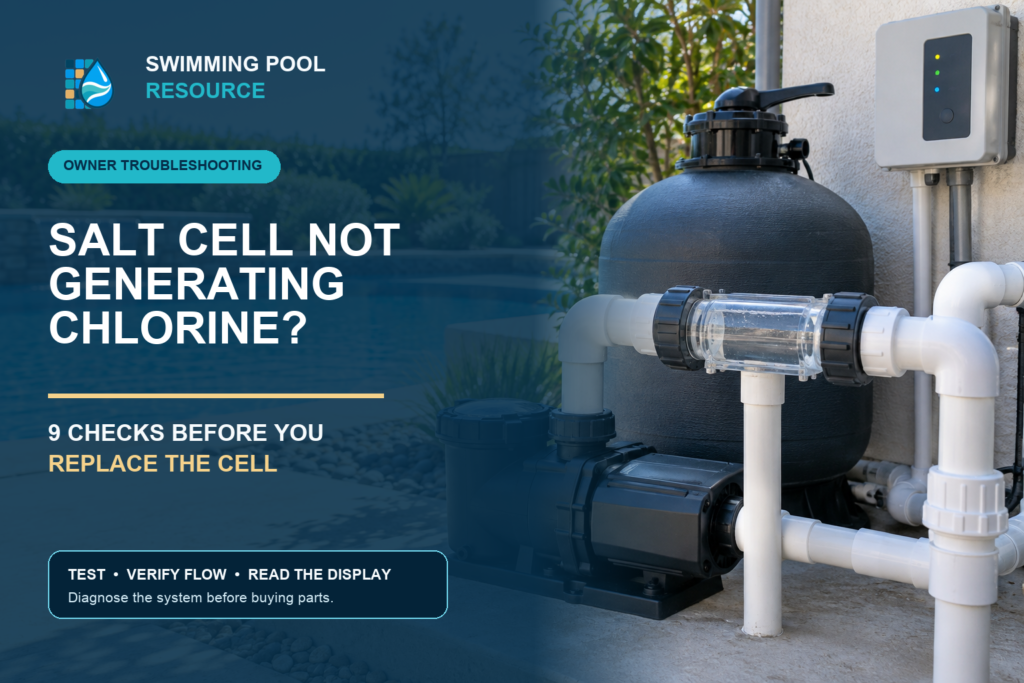
SALT CELL NOT GENERATING CHLORINE
If your salt cell is not generating chlorine, do not order a replacement yet. A low output setting, short pump schedule, weak water flow, cold water, an inaccurate salt reading, scale on the blades, or unusually high chlorine demand can all create the same symptom. The safest approach is to verify the pool and the equipment in a logical order.
This guide walks through nine checks an owner can make without opening electrical equipment or bypassing a safety device. Keep swimmers out if you cannot maintain a safe sanitizer level, and use an independently measured free-chlorine result—not bubbles or a controller light—as your final evidence.
Safety before troubleshooting
- Never bypass a flow switch or force a generator to run without confirmed circulation.
- Turn off the pump, disable automatic restart, and relieve system pressure before removing a cell.
- Do not open a power center or handle wiring unless you are qualified for that electrical work.
- Follow the exact manufacturer manual and chemical label. Never mix acid with chlorine products.
What “not generating” can actually mean
A salt-chlorine generator converts chloride in dissolved salt into chlorine while water is flowing through its cell. It does not make chlorine continuously just because the pool contains salt. The circulation system must be running, the controller must call for output, the safety conditions must be satisfied, and the cell must still have usable life.
It is also possible for the cell to generate chlorine while the pool still tests low. Strong sunlight, heavy swimming, organic debris, algae, contamination, or an unsuitable stabilizer level can consume chlorine faster than the equipment supplies it. That distinction matters: replacing a working cell will not solve excessive chlorine demand.
| What you see | What it may suggest | Best next check |
|---|---|---|
| No lights or display | Schedule, power, fuse, breaker, or controller problem | Confirm the system is supposed to be on; leave live electrical testing to a qualified professional |
| Low-flow warning | Water level, basket, valve, filter, pump speed, air leak, or sensor issue | Restore steady circulation before judging the cell |
| Low- or high-salt warning | Actual salinity outside the model range, calibration difference, temperature, or cell condition | Verify salt independently before adding or draining water |
| Cold-water or standby status | Model-specific temperature protection or schedule | Compare the water temperature and display status with the manual |
| “Generating” but free chlorine stays low | Short runtime, low output, high chlorine demand, undersized cell, or aging cell | Measure chlorine loss and compare daily production with pool needs |
| Inspect/check-cell warning | Scheduled inspection, scale, debris, sensor issue, or reduced cell life | Use the model’s diagnostic and inspection procedure |
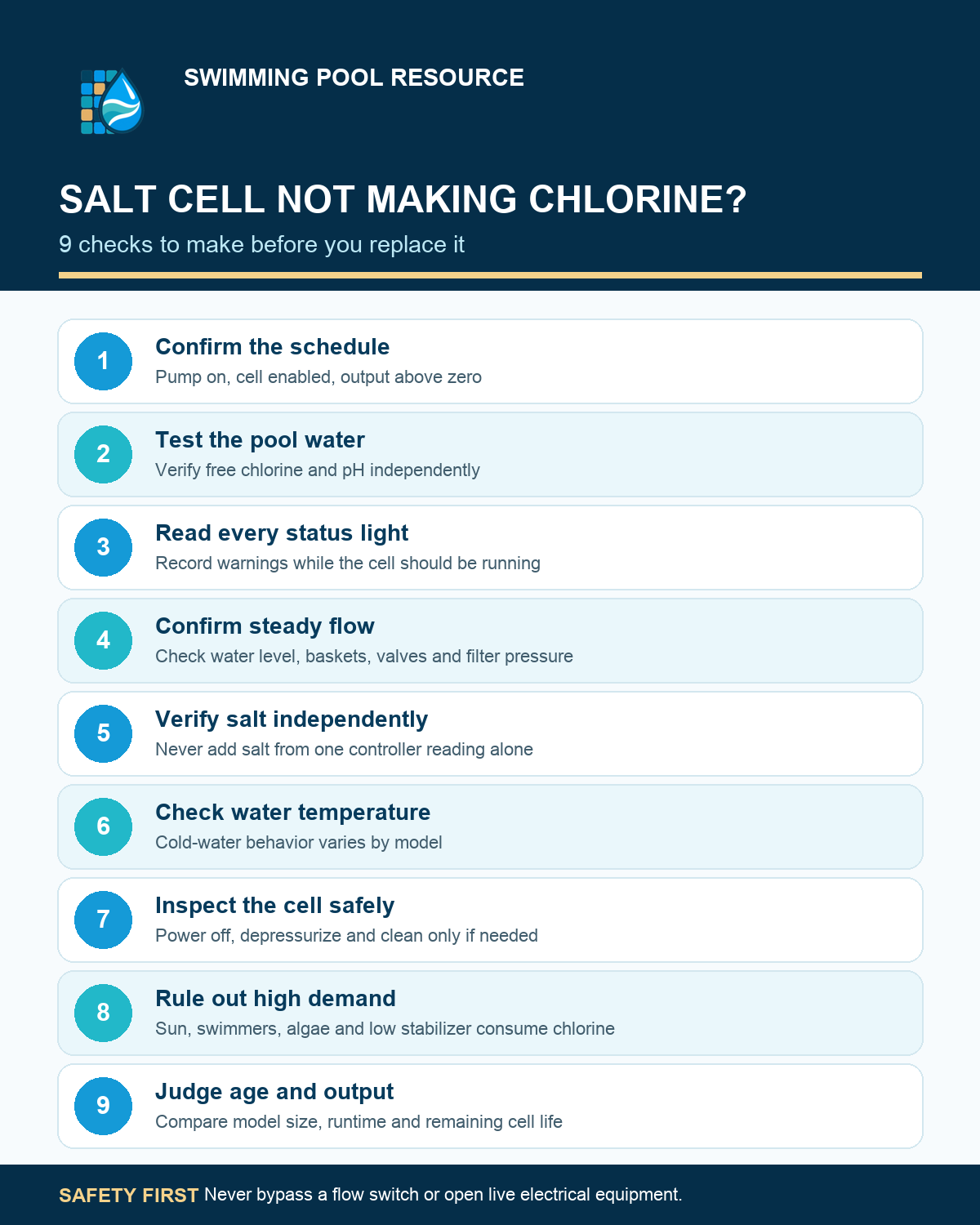
Salt cell not generating chlorine: 9 checks
1. Confirm the pump schedule and chlorine-output setting
Start with the simple possibility: the system may not be commanded to generate. Confirm that the circulation pump is actually running during the programmed window, the salt system is enabled, and its output is above zero. Check whether a recent power outage, seasonal schedule, service mode, freeze-protection cycle, or automation change shortened the run time.
Output is usually a percentage of the time the cell is energized while the pump runs—not a direct chlorine reading. A 50% setting during an eight-hour qualifying run is not the same as 50% production for 24 hours. Record the pump hours and output percentage so you can compare changes.
2. Test free chlorine and pH independently
Use a dependable drop-based kit or another trusted test method to measure free chlorine and pH. A cell light tells you what the controller is attempting; it does not prove that the entire pool holds an adequate residual. The CDC notes that chlorine and pH are the first defense against germs, so keep swimmers out when sanitation is uncertain.
Take a sample away from return jets, test according to the kit instructions, and record the time. If readings are surprising, review how to test pool water accurately before making multiple chemical changes.
3. Read the controller while the cell should be producing
Photograph the complete display, indicator lights, error codes, output percentage, salt reading, and water temperature while water is moving and the controller should be generating. Some diagnostic values appear only during an active production cycle. A normal-looking standby screen can therefore hide the clue you need.
Use the exact model number—not only the brand—to interpret the display. Manufacturers use different light patterns, salt targets, flow thresholds, cold-water behavior, and reset procedures. The model label and manual are more reliable than a generic online code list.
4. Confirm adequate, steady water flow
A salt cell requires enough flow for safe operation. Check the pool water level, skimmer and pump baskets, valve positions, visible air under the pump lid, return strength, and filter pressure relative to your clean baseline. Variable-speed pumps may need a higher speed during the salt system’s production window.
If you see a flow warning, correct the circulation problem first. Work through the low-pool-flow troubleshooting guide. Never defeat the flow switch: chemical systems operating without adequate water movement can create dangerous conditions.
5. Verify the salt level with an independent test
Do not add salt based only on the number shown by the controller. Compare it with a fresh independent salt test and the acceptable range in your model manual. Cell condition, water temperature, calibration, and test limitations can contribute to disagreement.
More salt is not automatically better. Too little can prevent output, while too much may trigger protection or require partial dilution. If the readings disagree substantially, investigate before adding anything. Salt does not evaporate; it normally leaves through splash-out, backwashing, overflow, leaks, or draining.
6. Check the water temperature and model cutoff
Many salt systems reduce output or stop generating in cold water, but the threshold is model-specific. One Hayward manual, for example, describes reduced output from 50–60°F and no generation below 50°F for that particular system. Do not apply those numbers to every brand.
Compare the controller’s temperature reading with a separate thermometer and the official manual. If the pool is cold and the display indicates cold-water protection, the cell may be functioning exactly as designed. Follow a label-approved winter sanitation plan instead of trying to override the cutoff.
7. Inspect the cell for scale or debris—safely
Turn off power, prevent an automatic restart, close or position valves as the manual requires, and relieve pressure before removing the cell. Look through the housing or inspect the blades only as the manufacturer directs. White crust, calcium deposits, leaves, or other debris can interfere with performance or sensing.
Clean only when inspection shows it is needed. Unnecessary acid exposure can shorten cell life. Use the approved stand, procedure, protective equipment, and dilution in the exact manual; always add acid to water, never water to concentrated acid. The detailed salt-cell cleaning guide explains the safe decision process.
8. Separate low production from high chlorine demand
If the system reports normal operation but free chlorine still falls, ask where the chlorine is going. Warm sunny weather, heavy bather load, storms, fertilizer, leaves, algae, and other organic contamination can consume sanitizer quickly. Too little stabilizer can increase sunlight loss, while too much can change the chlorine level needed for effective sanitation.
Review the guides for a pool that keeps losing chlorine and high cyanuric acid. Address active algae or contamination with a verified treatment plan rather than assuming the salt cell alone can catch up.
9. Compare cell size, runtime, age, and actual output
A correctly operating cell may still be undersized for the pool or scheduled too briefly for current conditions. Find the rated chlorine production for the exact model, confirm pool volume, and compare the daily runtime and output setting with demand. Manufacturer ratings are usually maximum production under defined conditions, not a promise that every pool will maintain its residual at a low setting.
Salt cells are consumable components. Output declines with operating hours, water balance, scale, cleaning history, and environment. If flow, salt, temperature, chemistry, schedule, and demand all check out—but diagnostic values or a qualified test show weak production—the cell may be near the end of its useful life.
How to confirm whether the cell is actually producing
The most useful proof combines several observations: the controller shows an active generating state, flow and salt are in the model’s acceptable range, diagnostic values are reasonable, and independently tested free chlorine responds over a controlled period. Some systems may show fine bubbles at a return while producing, but bubbles alone are not a dependable output measurement.
For a short diagnostic window, record free chlorine, pump runtime, output setting, weather, and swimming load. Make only one sensible change at a time, then retest. Do not perform an improvised electrical or chemical test at the cell. A dealer or qualified pool professional can use model-specific diagnostics when the safe owner checks remain inconclusive.
When to call a professional
- The breaker trips, a power center is damaged, wiring is exposed, or there is a burning smell.
- The controller shows low flow after baskets, valves, water level, filter condition, and pump speed are checked.
- Independent salt and temperature readings differ greatly from the controller.
- The cell leaks, its housing is damaged, or connections overheat.
- You cannot maintain a safe chlorine residual after correcting chemistry and demand.
- Replacement requires plumbing, bonding, automation, or electrical work beyond your qualifications.
The practical takeaway
A salt cell not generating chlorine is a symptom, not a diagnosis. Confirm the schedule, measure the water, record the display, restore flow, verify salt and temperature, inspect the cell, and rule out high demand before replacing it. That order protects the equipment—and your wallet—from guesswork.
New to salt systems? Start with how saltwater pool systems work, browse the equipment guide, or ask Chris about your pool.
Frequently asked questions
How can I tell if my salt cell is producing chlorine?
Verify that the system is in an active generating state, review model-specific diagnostics, and measure free chlorine independently before and after a controlled production period. A light or a few bubbles alone do not prove adequate pool-wide sanitation.
Why does the controller say “generating” when chlorine is low?
The cell may be operating but producing less chlorine than the pool is consuming. Check runtime, output percentage, sunlight, swimmer load, debris, algae, stabilizer, pool volume, and cell size before assuming the controller is wrong.
Should I add salt when the system reports low salt?
Not until an independent test confirms the result and you compare it with the exact model’s range. Adding salt is easy; removing too much generally requires draining or dilution.
How often should I clean a salt cell?
Inspect it at the interval in the manufacturer manual and clean only when scale or debris requires it. Water balance, cell design, runtime, and local conditions affect the interval. Excessive acid cleaning can shorten cell life.
When should a salt cell be replaced?
Consider replacement after confirming flow, salt, temperature, water balance, schedule, demand, and model-specific diagnostics. A check-cell or life warning can support the diagnosis, but scheduled reminders and scale should be ruled out first.
About the author
Chris Barnes is a former pool-service company owner with more than seven years of residential and commercial pool-service experience. Swimming Pool Resource turns field experience and manufacturer guidance into practical steps homeowners can use to troubleshoot, service, and maintain their pools.
Last reviewed: September 10, 2026. This article is educational and does not replace the instructions for your exact equipment, product labels, electrical codes, or local health requirements.