
By Chris Barnes · Former pool-service company owner · 7+ years of residential and commercial experience
Learning how to balance pH in pool water is less about chasing one perfect number and more about following a repeatable sequence: verify the test, understand what else is affecting the water, make one label-directed adjustment, circulate, and retest.
pH affects swimmer comfort, sanitizer performance, equipment, and pool surfaces. CDC recommends keeping home pool pH between 7.0 and 7.8. Many equipment manufacturers publish a narrower preferred range—often around 7.2–7.6 or 7.4–7.6—for their products. Use the range required by your exact sanitizer system, heater, pool finish, test method, product label, and local rules.
Safety first: Keep swimmers out while adding pool chemicals and for the full waiting period stated on the product label. Wear the protective equipment the label and Safety Data Sheet require. Open only one chemical container at a time, use clean dedicated measuring tools, and never mix pool chemicals. Never mix chlorine with acid. If a label directs pre-dissolving, add the chemical to water—never water to concentrated chemical.
Quick Answer: How to Balance pH in Pool Water
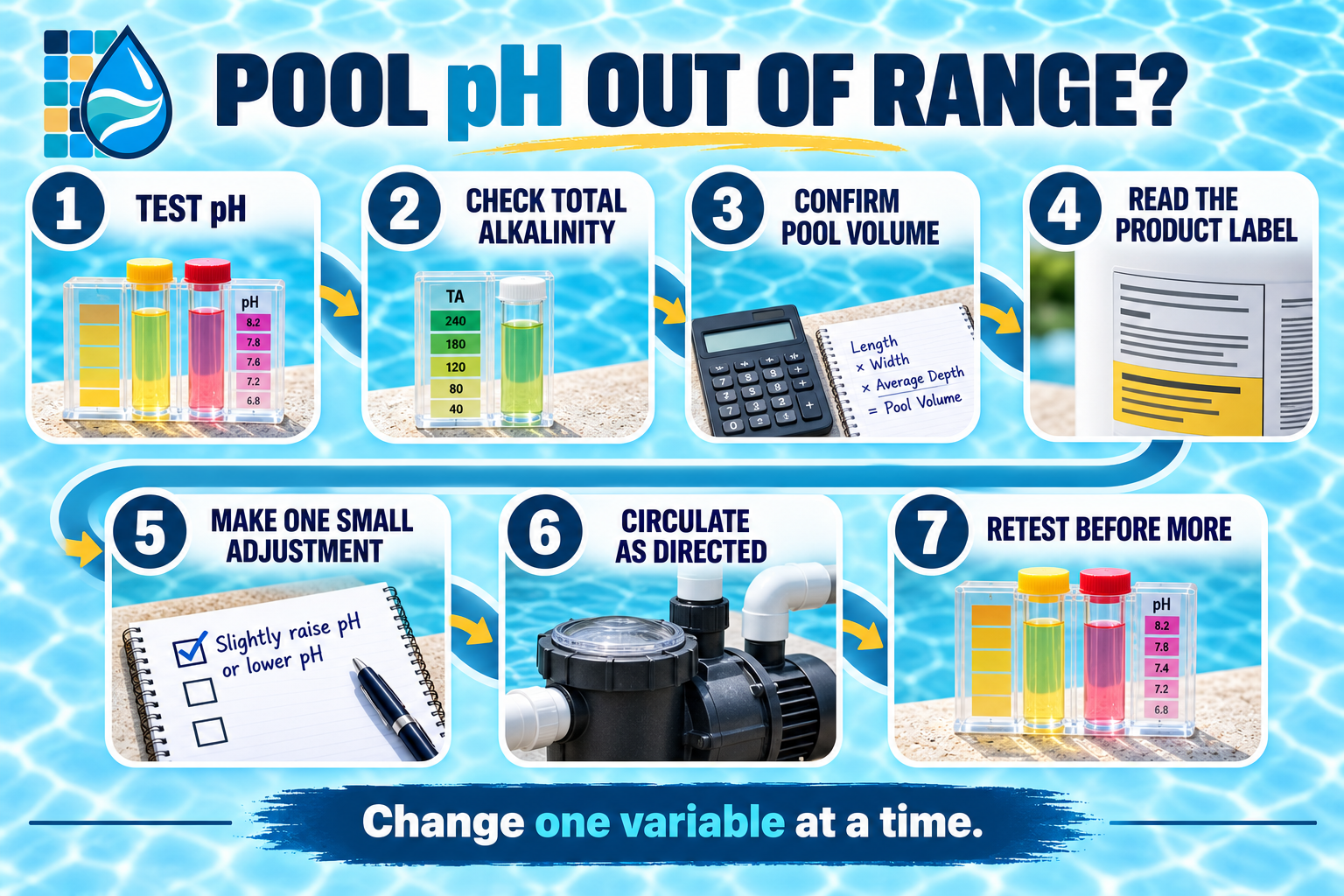
- Test pH with a reliable method and repeat any surprising result.
- Confirm the pump is circulating and the sample represents the pool.
- Test total alkalinity and review sanitizer, calcium hardness, stabilizer, temperature, and pool-surface requirements.
- Confirm the pool volume and read the exact adjustment product’s label.
- Select a product compatible with the installed equipment and current water balance.
- Make one measured adjustment and circulate exactly as directed.
- Retest after the required mixing time before adding anything else.
Do not add acid or pH increaser from a generic online dose. Product strength, starting pH, total alkalinity, pool volume, water temperature, treatment history, and the pool’s surface and equipment all affect the result.
What pH Means—and Why It Matters
pH describes how acidic or basic the water is. The scale is logarithmic, so a change of one whole pH unit is much larger than it looks. That is one reason small, measured corrections are safer than repeated large additions.
CDC says the 7.0–7.8 range best balances germ control, swimmer comfort, and the lifespan of pipes. As pH rises—especially above 8.0—chlorine becomes less effective at killing germs. When pH falls below 7.0, water becomes more likely to contribute to corrosion and deterioration.
The best operating target can be narrower than the broad public-health range. For example, current manufacturer guidance for some filters and salt systems lists preferred pH ranges from 7.2–7.6 or 7.4–7.6. Treat those as equipment-specific guidance, not a universal recipe.
| What you find | What it can mean | Best next check |
|---|---|---|
| pH is high and total alkalinity is high | The water may resist a small pH-lowering adjustment | Verify both tests and use the label’s demand/dose method |
| pH is high but total alkalinity is already low | A pH-only correction may push alkalinity lower | Review the full balance before adding acid |
| pH is low and total alkalinity is low | The water has little buffering and pH may swing easily | Address alkalinity in the order required by the product and system guidance |
| pH changes quickly after every correction | Testing, low buffering, aeration, new plaster, or an ongoing feed/source-water effect may be involved | Record pH, alkalinity, additions, runtime, and refill water |
| The test color is outside the comparator range | The number may not be reliable | Stop estimating and use a method that can measure the actual range |
| pH looks acceptable but water is cloudy or scaling | pH is only one part of water balance | Review alkalinity, calcium hardness, temperature, and saturation tendency |
pH and Total Alkalinity Are Related—but Not the Same
pH is the current acid/base condition of the water. Total alkalinity is its buffering capacity—how strongly the water resists a pH change. A pool can have an acceptable pH reading and still have alkalinity that makes the next change unstable.
This relationship explains two common problems:
- Low total alkalinity: pH may move too easily after rain, refill water, treatment, or normal use.
- High total alkalinity: pH may repeatedly drift upward or require more acid than expected to move.
Adjustment products also interact. Sodium bicarbonate primarily raises total alkalinity and may raise pH slightly. Sodium carbonate, commonly called soda ash, raises pH more strongly and can also raise alkalinity. Acid products lower pH and also reduce alkalinity. Some equipment manufacturers warn against particular products—for example, certain salt-chlorine-generator manuals advise against dry acid because of sulfate buildup—so the equipment manual matters.
Do not treat total alkalinity first as an inflexible rule in every situation. Instead, look at both results and use the sequence provided by the test system, treatment label, pool-surface guidance, and installed equipment manufacturer. When the readings conflict or the pool has a specialty surface, heater, salt system, or automation, qualified advice can prevent an expensive correction.
7 Safe Steps to Balance Pool pH
1. Verify the pH Test Before Treating
Start with a representative water sample and a test method you can read accurately. Follow the kit’s sample depth, fill line, reagent count, mixing method, lighting, and timing instructions. Use unexpired reagents stored as the manufacturer directs.
Repeat a result that is very different from the pool’s recent history. If the color is beyond the comparator’s range, do not guess the number. Obtain an in-range test or a second reliable measurement.
For a complete sampling routine, use the seven-step pool-water testing guide.
2. Confirm Circulation and Recent Treatment History
A sample taken beside a return, inside a poorly circulated step, during chemical addition, or before recently added treatment has mixed may not represent the entire pool. Confirm normal water level, pump prime, valve positions, return flow, and the circulation or wait time required by the last product used.
Write down what entered the water during the previous day: acid, pH increaser, sanitizer, shock, alkalinity product, fill water, rain, or a service treatment. This prevents two people from correcting the same reading twice.
3. Test the Factors That Change the Decision
At minimum, review pH, total alkalinity, and sanitizer together. Calcium hardness, cyanuric acid, temperature, salt-system operation, and the pool finish may also affect the correction or the broader balance.
Do not confuse a safe pH reading with complete water balance. Taylor Technologies notes that pH, total alkalinity, calcium hardness, temperature, and dissolved solids interact in saturation-index calculations. High-side balance can encourage scale and cloudiness; low-side balance can become corrosive or damaging to cementitious surfaces and metals.
4. Confirm the Pool Volume
An incorrect volume turns a correct label into an incorrect treatment. Use measured dimensions, average depth, and the shape formula appropriate for the pool. Include connected spa or water-feature volume only when that water is part of the active circulation system during treatment.
If the pool has an irregular shape or the historical volume is only an estimate, choose the conservative label-directed approach and verify the response before making another addition.
5. Choose the Right Compatible Adjustment
If pH needs to rise, the label or treatment system may call for a pH increaser such as sodium carbonate. If pH needs to fall, it may call for an acid product. The chemical name alone is not enough: strengths and formulations vary, and the installed equipment may limit what can be used.
Read the complete label and the equipment manual. Confirm that the product is intended for your pool type and compatible with the sanitizer system, heater, finish, and current chemistry. If you cannot identify a product, its concentration, or its label, do not use it.
6. Make One Measured Adjustment and Circulate
Follow the product label for the amount, application point, pump operation, personal protective equipment, swimmer exclusion, and any pre-dissolving instruction. Measure with a clean, dry tool dedicated to that product.
Do not combine additions in one bucket or make simultaneous corrections at different points around the pool. One measured change makes the result easier to evaluate and reduces the chance of an incompatible mixture or overshoot.
Review the pool-chemical safety guide before handling unfamiliar products.
7. Retest Before Adding More
Allow the full circulation and wait time required by the label, then collect a new representative sample. Retest pH and the related values the correction may have changed—especially total alkalinity after acid or carbonate products.
Record the result, time, pump setting, and amount added. If the reading is moving in the correct direction, another small label-directed step is easier to control than one large correction. If it barely moves, shifts unexpectedly, or rebounds quickly, stop adding and diagnose why.
Why Pool pH Keeps Rising or Falling
Repeated drift is a pattern to diagnose, not a reason to keep adding more product automatically.
Common reasons pH keeps rising
- total alkalinity is high for the pool’s system;
- aeration from waterfalls, spillovers, spa jets, or return placement releases dissolved carbon dioxide;
- a salt chlorine generator or other operating pattern contributes to upward drift;
- new plaster or cementitious surfaces are still curing;
- refill water enters with a different pH and alkalinity;
- an automated feed system is miscalibrated, empty, clogged, or running without proper flow control.
Common reasons pH keeps falling
- an acidic sanitizer or treatment is used regularly;
- total alkalinity is too low to buffer change;
- acid is being added too frequently or from an incorrect pool-volume estimate;
- refill water or rain changes the chemistry;
- an automated controller, probe, or feed pump is inaccurate or overfeeding.
Track several test-and-treatment cycles before drawing a conclusion. The pattern is more useful than one isolated reading.
What Not to Do
- Do not mix chlorine and acid; toxic gas can form.
- Do not pour water into concentrated pool chemical.
- Do not use an unlabeled, deteriorated, wet, or contaminated product.
- Do not use one scoop or cup as a universal dose for every product and pool.
- Do not make a second adjustment before the first one has circulated for the label-required time.
- Do not rely on pH alone when alkalinity, calcium, stabilizer, temperature, and equipment requirements matter.
- Do not let swimmers enter until the label’s waiting time has passed and the water has been retested.
- Do not service an automatic chemical feeder while it or the circulation system is running.
When to Call a Pool Professional
Get qualified help when the pH remains outside the measurable range, changes sharply after every correction, or is paired with widespread scale, etching, metal staining, cloudy water, heater warnings, or equipment damage. Stop and get help for a chemical spill, strong fumes, breathing or eye irritation, a damaged container, an unlabeled chemical, or any suspected mixing of incompatible products.
A professional should also inspect automatic chemical controllers and feed equipment that operate without flow, overfeed, leak, or disagree with a reliable manual test. Bring a record of the pool volume, surface type, equipment models, sanitizer system, recent additions, and repeated test results.
Frequently Asked Questions
What pH should a home swimming pool have?
CDC recommends 7.0–7.8. Many pool-equipment manuals specify a narrower preferred range, such as 7.2–7.6 or 7.4–7.6. Follow the requirements for the exact sanitizer system, heater, pool finish, test method, and local rules.
Should I adjust total alkalinity or pH first?
Check both before treating. Total alkalinity buffers pH, and the same adjustment can affect both readings. Many water-balance systems address alkalinity before fine-tuning pH, but an out-of-range pH or equipment-specific requirement can change the sequence. Use the test system, product label, and equipment guidance rather than a universal rule.
How long should I wait to retest pH?
Use the circulation and retest interval on the product label. It depends on the product, application method, pump operation, pool volume, and water conditions. Testing too soon can lead to a second unnecessary addition.
Why did my pH go up again after I lowered it?
High alkalinity, strong aeration, new plaster, salt-system operation, refill water, or a feed-system problem can contribute to recurring upward drift. Record pH and alkalinity under the same operating conditions and look for a repeatable pattern.
Can I swim when pH is out of range?
Wait until the water meets the applicable pH and sanitizer requirements and the adjustment product’s return-to-swim directions. CDC notes that out-of-range pH can reduce disinfectant performance, irritate swimmers, and damage equipment.
The Bottom Line
Knowing how to balance pH in pool water safely starts with slowing the process down. Verify the test, check total alkalinity and the wider water balance, confirm volume, choose a compatible labeled product, make one measured adjustment, circulate, and retest. That sequence protects the water, the equipment, and the people using the pool—and prevents an avoidable cycle of correction and overcorrection.
New to the routine? Begin with Pool Care for Beginners. If a pH problem is part of cloudy water, use the cloudy-pool troubleshooting guide before adding another product. For a stubborn or unusual pattern, ask Chris about your pool and include the test results, pool volume, equipment models, and recent treatment history.
Sources and Review Notes
Written and field-reviewed by Chris Barnes. Former Northern California pool-service company owner with more than seven years of residential and commercial experience. Last reviewed September 11, 2026. Product labels, equipment manuals, pool-surface requirements, and applicable local rules take priority.