
By Chris Barnes · Former pool-service company owner · 7+ years of residential and commercial experience
Pool still cloudy after shock? The treatment may have addressed part of the problem, but it does not remove every particle from the water—and it cannot compensate for weak circulation, a loaded filter, an inaccurate test, or an unresolved water-balance issue.
If the pool is still cloudy, resist the urge to add another product immediately. Test the water, confirm the pump and filter are working normally, and identify whether the cloudiness is improving, unchanged, or getting worse.
Safety first: If you cannot clearly see the bottom of the deepest part of the pool or the main drain, keep everyone out. Reduced visibility is a drowning and rescue hazard. Follow the treatment label’s waiting and testing requirements before anyone swims.
The quick answer
A pool may remain cloudy after shocking because the treatment created fine material that still needs to be filtered, the filter is loaded or bypassing debris, circulation is weak, the sanitizer was consumed by a continuing contaminant load, or a large chemistry change caused minerals or other material to come out of solution.
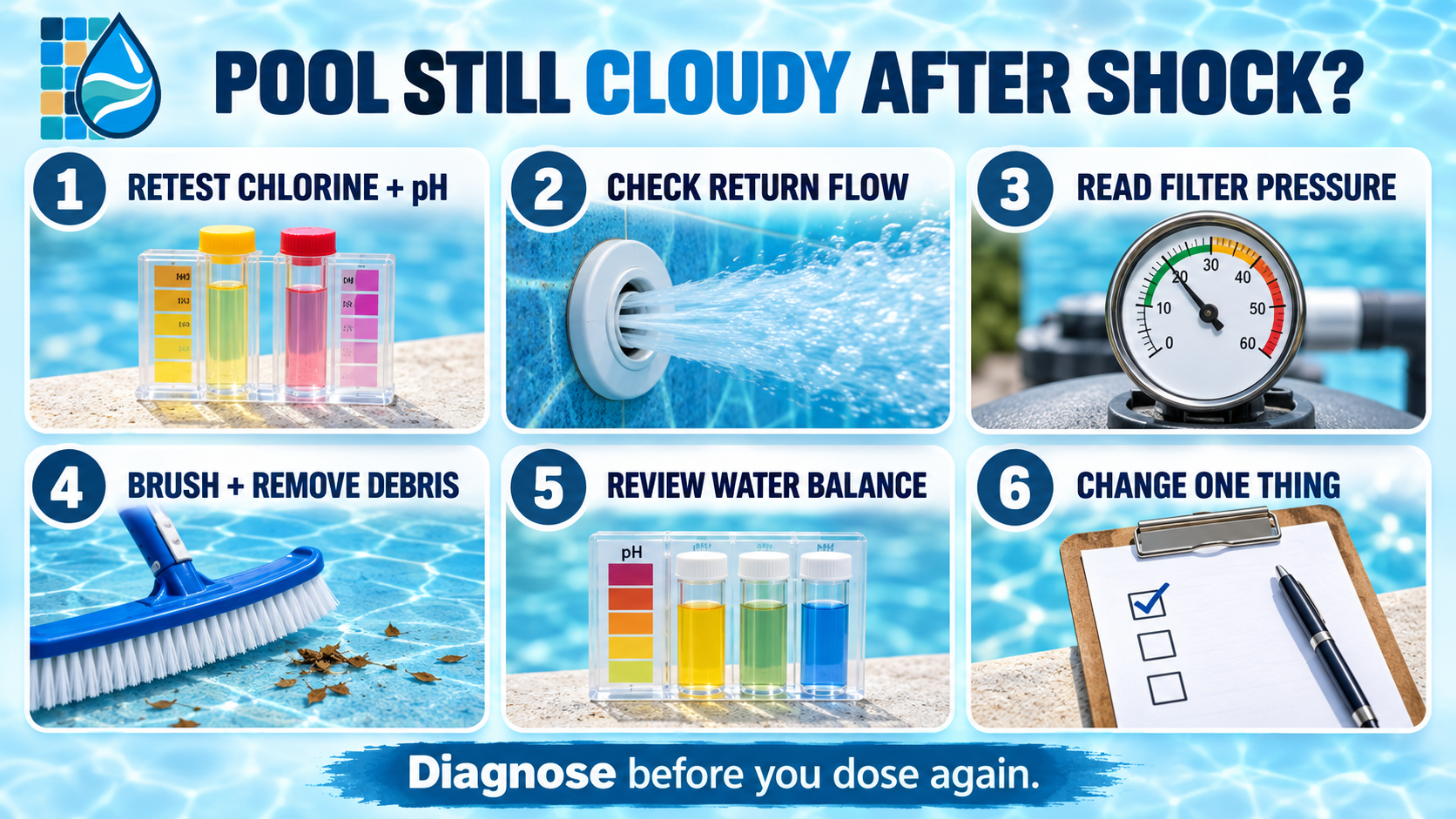
Work in this order:
- Read the product label and allow its required circulation and wait time.
- Retest free chlorine and pH accurately.
- Confirm water level, baskets, pump prime, valves, and return flow.
- Compare filter pressure with the clean baseline.
- Brush and remove settled debris.
- Change only one variable at a time.
Adding more shock before those checks can waste product, hide the original cause, or push the water farther out of balance.
First, confirm what “shocking” meant
“Shock” is used as a broad term, but products and procedures differ. Some treatments use chlorine; others use a non-chlorine oxidizer. Concentration, application method, circulation time, retest timing, and return-to-swim requirements come from the exact label—not from a universal scoop count or online recipe.
Write down:
- the exact product and active ingredient;
- how much was added;
- the pool volume used for the calculation;
- the time it was added;
- the pump setting and runtime afterward;
- the water-test results before and after treatment.
If any of those details are uncertain, do not stack another treatment on top. Confirm the pool volume, read the label again, and obtain a reliable test.
Seven reasons the water can stay cloudy
1. The filter has not removed the fine material yet
Sanitizer can kill or oxidize contaminants without making them disappear. Dead algae, oxidized material, pollen, dust, and other fine particles still have to settle, be vacuumed, or pass through a working filter.
The right response is not automatically “more shock.” Check whether return flow is steady, the pump remains primed, and filter pressure is behaving normally. Give the filter the circulation time required by the treatment and equipment instructions, while monitoring it for changing pressure or flow.
2. The filter is loaded, damaged, or bypassing water
A filter that is collecting debris may rise above its clean starting pressure. A pressure reading that is unusually low can instead point toward reduced flow before the filter. A gauge stuck at zero may simply be faulty.
Compare the reading at the same pump speed and valve configuration used to establish the clean baseline. Clean or backwash only by the instructions for the exact cartridge, sand, or D.E. filter. Never loosen a filter clamp or lid on a running or pressurized system.
If pressure and return flow look normal but cloudiness never improves, the filter may have a torn cartridge, damaged grid, channeling media, an internal valve problem, or another condition that allows debris to bypass filtration. Those checks may require a qualified pool professional.
3. Circulation is weaker than it appears
A running pump does not prove that the whole pool is circulating well. Check:
- water level around the middle of the skimmer opening;
- a skimmer weir that moves freely;
- clear skimmer and pump baskets;
- a pump pot that stays mostly full of water;
- intended suction and return valves in their normal positions;
- steady flow at the return jets;
- no persistent bubbles or growing air pocket under the pump lid.
If the pump is losing prime, drawing air, or producing weak returns, solve that flow problem before expecting the filter to clear the water. Use the pool-pump priming guide or the pool-pump air-leak guide to narrow it down safely.
4. The test result is misleading
High sanitizer levels can interfere with some color tests. CDC notes that a DPD chlorine test may partially or completely bleach out when chlorine is above 10 ppm, producing a falsely low or zero result.
If a post-treatment reading seems impossible, do not assume the chlorine vanished and add more. Follow the test-kit instructions, check the kit’s measurement range, use fresh reagents, and retest at the time the treatment label specifies. A pool store or qualified service professional can provide a second measurement when the result is still unclear.
5. The contaminant demand is still active
Leaves, pollen, soil, sunscreen, heavy swimmer use, algae, and other organic material consume sanitizer. If debris remains in the pool—or algae is still established in shaded areas, behind ladders, or inside steps—the treatment may have addressed only part of the load.
Brush the pool, empty the baskets, and vacuum settled material. Test again before making another adjustment. A repeatable drop-based test is more useful than judging progress by color alone. If sanitizer still falls after cleanup, use the chlorine-loss diagnostic guide to separate sunlight, contamination, circulation, dilution, equipment delivery, and testing problems.
6. Water balance or minerals are contributing to haze
A sudden pH change, high calcium conditions, incompatible additions, or treatment added without adequate circulation can produce a pale, milky haze that is not the same as living green algae.
Test pH first, then review total alkalinity, calcium hardness, and stabilizer when the history or surface type makes them relevant. Do not lower or raise several readings at once. Large chemistry corrections should be based on accurate volume, reliable testing, the product label, and the needs of the pool finish and equipment.
7. Too many “helper” products were added
Clarifiers, flocculants, algaecides, phosphate products, enzymes, and other treatments each have specific uses and limitations. Combining them without a diagnosis can create more fine material, interfere with filtration, or make the next test harder to interpret.
A clarifier is not a substitute for adequate sanitizer, circulation, or a working filter. A flocculant may require a particular filter setting and vacuum-to-waste procedure that some systems cannot support. Use either only when the label and the equipment arrangement make it appropriate.
Pool Still Cloudy After Shock: What the Pattern Tells You
| What you see | More likely direction | Next check |
|---|---|---|
| Water is slowly improving, filter pressure is rising | The filter is collecting fine material | Follow the filter manual’s cleaning trigger and keep monitoring flow |
| Water is unchanged and returns are weak | Circulation or filtration problem | Check water level, baskets, pump prime, valves, and pressure baseline |
| Water briefly clears, then clouds again | Continuing contaminant load or incomplete removal | Brush, vacuum, retest, and inspect hidden low-circulation areas |
| Chlorine appears to read zero immediately after treatment | Possible test interference or heavy demand | Verify the kit range and retest correctly before adding more |
| Water turns pale or milky after a large adjustment | Possible precipitation or product interaction | Test pH and relevant balance factors; avoid another large correction |
| Filter pressure is unusually high | Restriction after the pump or loaded filter | Shut down if flow is poor and follow the filter manual |
| Filter pressure is unusually low | Reduced water reaching the pump or a flow problem | Check baskets, water level, valves, prime, and suction-side air |
A safe recovery checklist
1. Keep swimmers out until visibility and chemistry are safe
You should be able to see the bottom of the deepest area clearly. The treatment label may also require a specific waiting period and verified sanitizer and pH range.
2. Remove the debris you can see
Empty baskets and skim leaves. Brush walls, steps, corners, ladders, and shaded areas so the remaining material can be filtered or vacuumed.
3. Test before adding
Measure free chlorine and pH with a reliable kit. Repeat surprising results. Add alkalinity, calcium, stabilizer, and combined-chlorine testing when they help explain the specific condition.
4. Confirm the complete flow path
Check the pool water level, skimmer action, pump basket, lid seal, pump prime, valve positions, return strength, and visible air. Compare what you see with the pool’s normal baseline.
5. Read the filter, not the calendar
Use the clean starting pressure and the manual for the exact filter. A fixed “clean every few days” rule ignores filter size, debris load, pump speed, and media type.
6. Make one correction
Choose the change supported by the evidence, follow its label or manual, record it, allow the required circulation time, and retest. Do not add several products in quick succession.
Chris’s service-route lesson
One stubborn cloudy pool on my service route had a pump that appeared to be running normally whenever I arrived. The missing piece was what happened between visits: the programmed runtime was not providing enough circulation and filtration for the pool’s conditions.
The lesson was simple. A treatment can be correct and the pump can be operating right now, yet the water may stay cloudy if filtration is not working long enough—or well enough—to remove what the treatment leaves behind.
When to call a pool professional
Get qualified help when:
- the bottom or main drain is not visible;
- you cannot obtain a believable sanitizer or pH result;
- the filter tank, clamp, lid, gauge, or air-relief assembly is damaged;
- the pump loses prime, trips a breaker, overheats, leaks near the motor, or makes severe noise;
- cloudiness persists despite verified chemistry and normal circulation;
- you suspect metal staining, calcium precipitation, damaged filter media, or an internal valve problem;
- the recovery would require draining, electrical work, opening a pressure vessel, or handling a chemical procedure outside your experience.
Frequently asked questions
Should I add more shock if the pool is still cloudy?
Not until an accurate test and the product label support it. Cloudiness alone does not show that sanitizer is low, and a very high chlorine level can make some DPD tests appear falsely low.
How long should a cloudy pool take to clear after shocking?
There is no universal number of hours. The contaminant load, filter type and condition, circulation, water balance, treatment used, and amount of debris all matter. Look for measurable progress in clarity, pressure, flow, and test results rather than relying on a fixed countdown.
Should I run the pump continuously?
Follow the treatment label and the pump and filter manuals. Extended circulation can help only when the pump stays primed, the return path is open, and the filter is monitored. Do not leave a dry, air-bound, leaking, overheating, or highly pressurized system running.
Will clarifier fix cloudy water after shock?
It may help a compatible filter capture very fine particles, but only after sanitizer, circulation, filtration, and water balance have been checked. Follow the exact label; overdosing or using the wrong procedure can make the problem harder to resolve.
Can I swim if the chemistry tests safe but the water is still cloudy?
No if you cannot clearly see the bottom of the deepest part of the pool or the main drain. Visibility is a separate safety requirement from the sanitizer and pH readings.
Diagnose before you dose again
When a pool stays cloudy after treatment, the best next step is usually better information—not another scoop. Verify the test, trace the circulation path, read the filter against its clean baseline, remove debris, and make one supported change at a time.
For the broader diagnostic order, use the cloudy-pool troubleshooting guide. New to the routine? Start with Pool Care for Beginners or ask Chris about your pool and include the test results, filter pressure, equipment models, and what changed before the cloudiness began.
Sources and review notes
Written and field-reviewed by Chris Barnes. Former Northern California pool-service company owner with more than seven years of residential and commercial experience. Last reviewed September 8, 2026. The product label and manuals for the exact installed equipment take priority.