
How to Clean a Pool Filter: Cartridge, Sand & D.E.
A safe, practical guide to knowing when your filter is dirty, choosing the correct cleaning method, and restarting the system without trapped air.
Clean by pressure—not by the calendar.
Record the pressure when the filter is clean and the system is running normally. Clean or backwash when the pressure rises by the amount specified in the filter manual, or when return flow drops noticeably.
A common manufacturer range is about 8–10 psi above the clean starting pressure, but the correct trigger for your equipment is the one printed in its manual.
Which kind of pool filter do you have?
Do not guess from the tank shape alone. Read the model label and look up the manufacturer's manual. The internal element tells you what kind of service it needs.
Pleated fabric elements
The tank opens and one or more pleated cartridges lift out. There is usually no backwash valve. The elements are cleaned with a garden hose.
A bed of filter sand
A multiport or slide valve sends water backward through the media and out a waste line. Routine cleaning is normally a backwash followed by a rinse.
Grids or cartridge-style elements
Diatomaceous earth coats internal grids and must be replaced after backwashing. Use only the exact type and quantity in your filter manual.
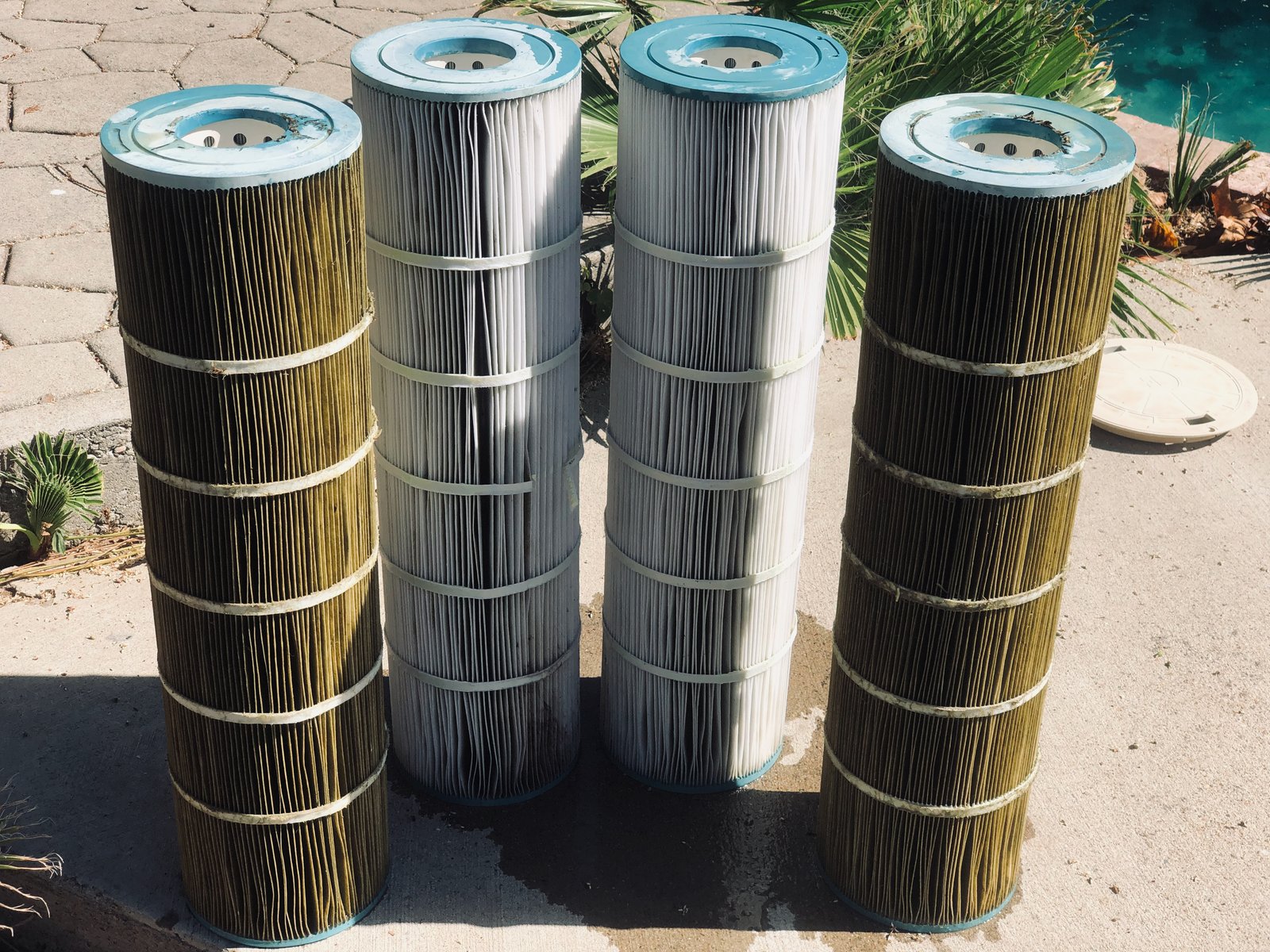
A clean cartridge should show open, evenly rinsed pleats.
The outer cartridges in this photo still hold green-brown buildup. The center pair shows what you are aiming for after a patient top-to-bottom rinse.
- Separate every pleat and work downward.
- Keep rinsing until runoff stays clear.
- Inspect for tears, crushed pleats, or cracked end caps before reinstalling.
Make the system safe first.
Use the exact disassembly and reassembly instructions for your model. This checklist is the common starting point—not a replacement for the manual.
- Stop the pump and disable automatic schedules.
- Switch off the pump circuit breaker.
- Open the manual air-relief valve fully.
- Wait for the pressure gauge to read zero.
- Confirm water has stopped flowing from the relief valve.
- Stand clear of the lid during shutdown and restart.
- Inspect the tank, clamp, lid, O-ring, and gauge.
- Keep the pump off whenever a multiport valve is moved.
How to clean a cartridge pool filter
Cartridges trap debris between deep pleats. A slow, top-to-bottom rinse preserves the media better than blasting it with excessive pressure.
Shut down and relieve all pressure.
Turn off the pump and breaker, open the air-relief valve, and verify the gauge is at zero before touching the clamp or lid.
Follow the model's disassembly sequence.
Remove the clamp and lid exactly as the manufacturer directs. Do not improvise with a damaged or unfamiliar clamp system.
Remove and inspect each cartridge.
Note how the manifold, cartridges, and spacers fit together. Look for torn fabric, cracked end caps, collapsed pleats, loose bands, or a damaged center core.
Rinse from top to bottom.
Use a garden hose with a straight-flow nozzle held at roughly a 45-degree angle. Work slowly between every pleat so debris moves down and away.
Clean the tank and sealing surfaces.
Flush loose debris from the tank. Clean the lid O-ring groove and sealing surfaces without scratching them. Replace an O-ring that is cracked, stretched, flattened, or nicked.
Reassemble exactly as designed.
Seat the cartridges, manifold, O-ring, lid, and clamp in the specified positions. Never force a clamp closed or use the pump to test an uncertain assembly.
Restart with the air relief open.
Stand clear, restore power, and start the pump. Close the air-relief valve only after a steady stream of water appears. Shut down immediately if the tank leaks or the lid does not remain secure.
How to backwash a sand pool filter
A sand filter is usually cleaned without opening the tank. The valve reverses flow through the sand bed and sends dirty water to the waste line.
Check the pool water level and waste route.
Backwashing removes water. Confirm the pool has enough water and that the waste line can discharge legally and safely without flooding property.
Turn the pump completely off.
Never rotate a multiport valve or move a slide valve while the pump is running.
Set the valve to Backwash.
Confirm the suction line and waste line are open. Lock the handle into the correct position for your valve.
Stand clear and start the pump.
Run until the sight glass or waste water is clear, using the time range in the manual. Pentair's Triton guide gives approximately 3–5 minutes as one model-specific example.
Stop the pump before moving the valve.
For a multiport valve, select Rinse. A two-position slide valve may not have a rinse setting—follow its manual.
Rinse briefly if the valve provides it.
Start the pump and rinse for the manual's specified time. Pentair's Triton guide uses about 30 seconds. Then turn the pump off again.
Return the valve to Filter.
Confirm the pool return line is open. Open the filter's manual air relief if the model has one.
Restart and vent the air.
Stand clear and start the pump. Close the air relief when a steady stream of water emerges.
Record the new starting pressure.
Verify steady return flow and check the waste line for leakage. Restore the pool water level after backwashing.
Neglected filters were a common sight when I went on service and sales calls. I cared for many pools on large rural properties, where sand filters were especially common because they were rugged, practical, and capable of handling substantial debris.
When a sand filter is not backwashed regularly, dirt can work deeper into the filter bed and become increasingly difficult to remove. Filtration and circulation may suffer, the sand can develop channels, and debris may begin returning to the pool. Many service companies immediately recommend replacing the sand, but that can be a costly and labor-intensive job.
When the tank, valve, laterals, and filter media still appeared serviceable, I first tried a series of controlled backwash-and-rinse cycles. I often had good results flushing accumulated contaminants from the sand and restoring the filter’s performance before resorting to replacement. This saved many customers money. Filter sand does not automatically need replacement on a fixed schedule; with proper backwashing and sound equipment, it can remain effective for many years. If debris continues returning or pressure and flow do not improve, the filter’s internal components and media should be inspected more closely.
How to clean and recharge a D.E. pool filter
D.E. filters combine pressurized-vessel hazards with a fine powder that must be handled carefully. If you do not know the filter model, grid area, valve sequence, or required recharge amount, stop and call a professional.
Routine backwash
- Disable power, verify the valve and waste route, and follow the exact backwash sequence in the manual.
- Keep the pump off every time the valve position changes.
- After returning to Filter, recharge immediately through the skimmer or the method specified by the manufacturer.
- Use the exact measured amount required for your model after backwashing—not a guess based on tank size.
Manual grid cleaning
- Shut off the breaker, open the air relief, and wait for zero pressure.
- Disassemble the tank exactly as the manual shows.
- Remove the grid assembly and rinse every grid with a garden hose.
- Inspect for torn fabric, broken ribs, a cracked manifold, or a damaged standpipe O-ring.
- Reassemble, restart with the relief open, and add the full manual-cleaning charge specified for the filter.
Use your clean starting pressure as the baseline.
Pentair's Clean & Clear guidance uses 8–10 psi above clean starting pressure as the cleaning trigger.
One Hayward commercial sand-filter manual uses a 7–10 psi rise; your residential model may differ.
Pentair's Quad D.E. guidance uses approximately 10 psi above starting pressure or a significant flow reduction.
These are examples, not universal settings. If pressure falls instead of rising, check pool water level, baskets, pump prime, valves, suction leaks, and the pressure gauge before blaming the filter.
What the pressure and flow are telling you
| Symptom | Likely direction | Best next step |
|---|---|---|
| Pressure is high and return flow is weak | Dirty filter, restricted return, partly closed valve, or incorrect valve position. | Verify the valve path. Clean or backwash only after a safe shutdown. |
| Pressure is low and return flow is weak | Low water, blocked skimmer or pump basket, suction restriction, air leak, or lost pump prime. | Check the suction side and prime the pump before opening the filter. |
| Dirt returns to the pool | Torn cartridge or grid, cracked manifold, damaged O-ring, bad lateral, or valve problem. | Stop filtering and inspect the correct internal parts for your model. |
| Pressure rises again quickly | Algae, heavy debris, scale, oily media, undersized filter, excessive pump flow, or incomplete cleaning. | Correct water chemistry and circulation; inspect or deep-clean the media as the manual allows. |
| Water leaks at the tank joint | Dirty or damaged seal, misaligned lid, clamp problem, or tank damage. | Shut down Turn off the breaker, vent all pressure, and do not restart until corrected. |
Cleaning cannot fix damaged media.
Replace a cartridge or D.E. grid when fabric is torn, pleats are collapsing, end caps are cracked, bands are broken, or debris bypasses after correct reassembly. A broken manifold, lateral, standpipe, clamp, gauge, or tank component also needs repair—not more cleaning.
Sand itself can last for years. Consider inspection or media service when backwashing no longer restores normal pressure and flow, the sand is clumped or channeled, or broken laterals are sending sand into the pool.
Pool filter cleaning FAQ
How often should I clean my pool filter?
Use pressure and flow, not a fixed calendar. Record the clean starting pressure, then clean at the pressure rise specified in the manual. Heavy debris, algae, construction dust, and frequent swimming can shorten the interval.
Can I clean a cartridge with a pressure washer?
No. A pressure washer can damage pleats and shorten cartridge life. Use a garden hose and a straight-flow nozzle, working carefully from top to bottom between the pleats.
Do I need to backwash a cartridge filter?
Most cartridge filters do not use a backwash valve. They are opened after a complete pressure-relief shutdown, and the removable elements are cleaned with a hose. Follow the model manual.
Do I have to add D.E. after every backwash?
Yes, a conventional D.E. filter must be recharged after backwashing. The exact amount and method vary by model and by whether the cleaning was a backwash or a full teardown. Use the filter label and manual.
Should I replace pool filter sand every year?
No universal annual replacement schedule applies. If correct backwashing restores normal pressure and flow, the media may still be working. Persistent problems can require deeper inspection for scale, clumping, channeling, or broken internal parts.
Why is the gauge still high after cleaning?
Possible causes include incomplete cleaning, restricted return plumbing, a partly closed valve, an incorrect multiport position, scale or oil in the media, excessive pump speed, or a faulty gauge. Shut down if pressure is abnormal.
Keep the whole circulation system healthy.
Filter cleaning solves captured debris. It does not correct algae, a suction leak, a blocked impeller, or unbalanced water. Use the equipment hub to trace the system or ask Chris about the setup at your pool.
Also helpful: prime a pool pump safely and troubleshoot cloudy pool water.
Sources and review notes
Written and reviewed by Chris Barnes. Last reviewed September 2, 2026. This guide is educational and cannot account for every filter, clamp, valve, automation system, discharge rule, or local code. The instructions and warnings for your exact equipment take priority.