
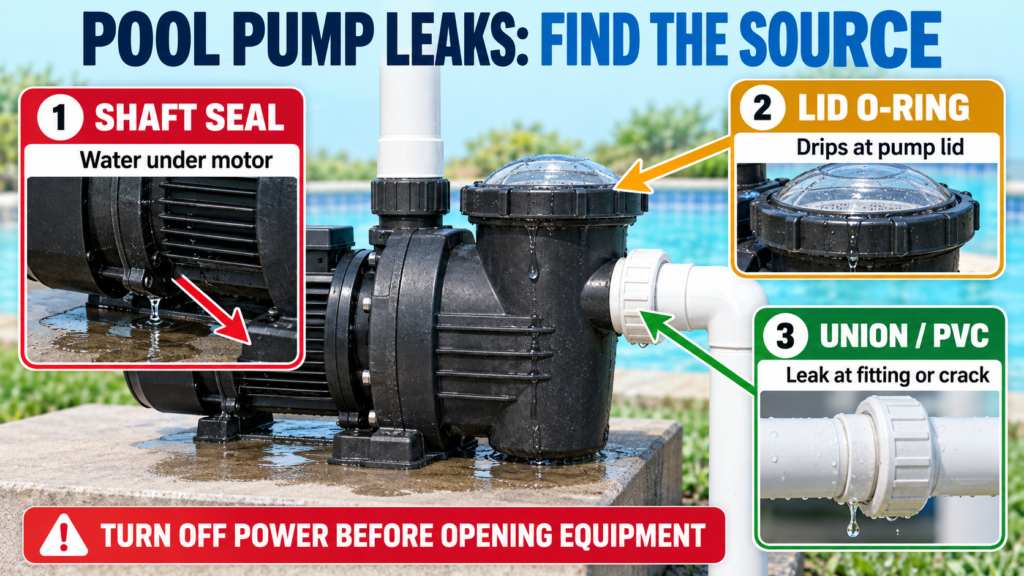
A pool pump leaking from the bottom is easy to ignore until it becomes a bigger equipment problem. Water around the pump can come from a simple lid O-ring, a worn shaft seal, a cracked union, or nearby PVC plumbing. The location of the water—and whether the pump is running—usually points you toward the right next step.
Start with safety
Turn off power at the breaker before opening a pump lid, loosening a union, or working around wet electrical equipment. Never remove a pump lid, clamp, or plumbing connection while the system is pressurized. If you are unsure how to isolate the pump or relieve pressure safely, call a qualified pool professional.
Where is the water coming from?
Water directly under the motor often points to a failing shaft seal. The seal sits between the wet end of the pump and the motor. When it wears out, water can escape along the shaft and eventually damage motor bearings or electrical components.
Drips at the clear pump lid are commonly related to the lid O-ring. Look for a flattened, dry, cracked, dirty, or twisted O-ring. A replacement O-ring or the correct manufacturer-approved lubricant is usually an inexpensive repair.
Water at a union or PVC fitting can be harder to diagnose. The union O-ring may be dirty, displaced, or worn—but sometimes the union itself or a glued PVC joint has a hairline crack. In that case, the damaged fitting may need to be replumbed rather than simply tightened.
Quick checks a homeowner can make
- Turn the pump off and dry the equipment area.
- Run the pump briefly and watch where the first bead of water appears.
- Inspect the pump lid and O-ring for debris, flat spots, or cracking.
- Check unions for moisture on the underside—not just the top.
- Look for water tracking from a higher fitting down the pump housing.
From the field: common pump-leak patterns
Over the years, I saw pump leaks caused by just about every part of the system. Shaft seals were the most common. Lid O-rings were usually easier to diagnose, and replacing or lubricating the O-ring was often an inexpensive fix. Unions could be trickier: if the internal O-ring was not the source, the union itself sometimes had a crack and needed to be replumbed with a new fitting.
When a shaft seal is likely
A leak beneath the motor or at the seam between the motor and wet end is a strong shaft-seal clue. Do not keep running a pump that is leaking into the motor area. A technician can confirm the source and inspect the impeller, seal plate, and motor bearings at the same time.
When a lid O-ring may be the answer
For a leak near the lid, remove the lid only with power off and pressure relieved. Clean the O-ring groove, inspect the ring, and replace it if it is damaged. Use only the lubricant recommended for your pump’s O-ring material; petroleum-based products can damage some rubber compounds.
When plumbing needs repair
Do not overtighten a union or PVC fitting. Excess force can damage threads, O-rings, or plastic parts. If a union body, threaded adapter, or glued joint is cracked, shutting the equipment down and having the fitting properly replaced is the durable fix.
When to call a pro
Arrange service if the leak is under the motor, the pump trips a breaker, the equipment pad stays wet, the housing is cracked, a threaded fitting is damaged, or you cannot positively identify the source. Water and electrical equipment do not mix, and a small ongoing leak can become a motor or plumbing replacement.
The bottom line
Start by locating the first point where water appears. A lid O-ring can be a quick and affordable repair, while a shaft seal or cracked union needs more involved work. Catching the leak early protects the pump and keeps the rest of the circulation system healthy.