
Professional-style pool water testing
Taylor K-2006 Test Kit Review
A practical look at Taylor’s FAS-DPD drop-test kit: what it measures, where its precision matters, and what first-time pool owners should know before choosing it.
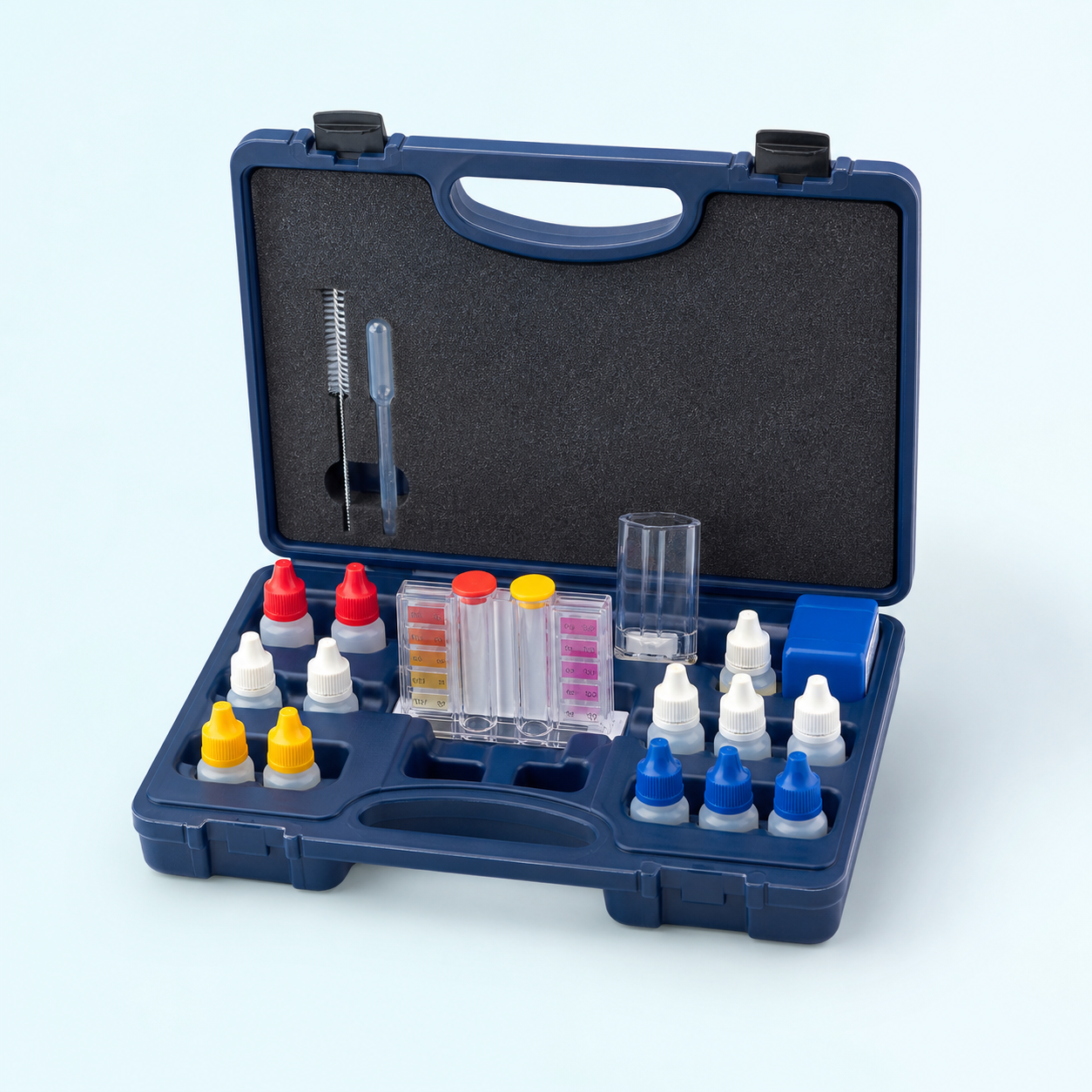
Original category illustration. Replace with an approved product-feed image before publication.
Quick editorial assessment
Who the K-2006 is designed for
Based on Taylor’s published specifications, this is a strong match for pool owners who want a complete drop-based kit and more precise chlorine readings than strips or a basic color comparator provide. The tradeoff is a longer testing routine and ongoing reagent care.
People willing to follow a repeatable testing process and make treatment decisions from measured results.
The FAS-DPD method measures free and combined chlorine by counting drops instead of judging a shade of pink.
It takes more time and technique than a test strip, and reagents must be stored properly and replaced by their best-by dates.
Verified manufacturer specifications
What the kit measures
The following details come from Taylor’s K-2006 product information and selection guide. They describe the kit—not personal test results.
| Test | Method or scale | Why it matters |
|---|---|---|
| Free chlorine | FAS-DPD; 0.2 or 0.5 ppm per drop, depending on sample size | Shows the active sanitizer available to control contaminants. |
| Combined chlorine | FAS-DPD drop count | Helps identify chloramines and whether the water may need corrective treatment. |
| pH | Phenol red comparator; 7.0–8.0 | Affects swimmer comfort, surface protection, and chlorine performance. |
| Acid demand | Drop test | Helps estimate how much acid may be needed to lower pH. |
| Base demand | Drop test | Helps estimate how much base may be needed to raise pH. |
| Total alkalinity | 10 ppm CaCO₃ per drop | Buffers pH and helps prevent rapid pH swings. |
| Calcium hardness | 10 ppm CaCO₃ per drop | Supports decisions that protect plaster, equipment, and water balance. |
| Cyanuric acid | Turbidimetric; 30–100 ppm in 10 ppm increments | Shows the stabilizer level that protects chlorine from sunlight. |
Manufacturer references: Taylor K-2006 product information and Taylor FAS-DPD brochure.
Why FAS-DPD matters
Count drops, not colors
For chlorine, the sample changes color and is titrated until it turns clear. Taylor states that a 25 mL sample reads in 0.2 ppm increments, while a 10 mL sample reads in 0.5 ppm increments.
That method is especially useful when a subtle color match would be difficult or when sanitizer levels are higher than a basic comparator can show.
K-2006 or K-2006C?
K-2006: 0.75 oz reagent bottles. This is the smaller version commonly considered for residential use.
K-2006C: 2 oz service-size reagent bottles. The chemistry and core tests are similar, but the larger bottles suit more frequent testing.
Confirm the exact model and included components with the seller before ordering.
Chris’s field perspective
Why repeatable testing matters more than guesswork
After years of servicing residential and commercial pools, the pattern was consistent: owners get into trouble when they add chemicals before they have dependable numbers. A drop-count kit encourages a slower, repeatable process—and gives you something useful to compare from one test to the next.
Where the K-2006 approach helps
- Free and combined chlorine: the FAS-DPD test uses a visible endpoint and a drop count instead of asking you to match two similar shades.
- Problem recovery: dependable chlorine readings matter when diagnosing cloudy water, algae, or unusually high chlorine demand.
- Trend tracking: writing down results makes it easier to see whether an adjustment worked instead of starting over each visit.
- One-kit discipline: keeping the core tests together reduces the temptation to treat water based only on appearance.
First-time owner mistakes to avoid
- Using the wrong sample volume for the drop factor in the instructions
- Losing count while adding drops or rushing the color endpoint
- Contaminating reagent tips or returning unused chemicals to a bottle
- Testing in poor light or reading a color test against a distracting background
- Storing reagents in heat, direct sun, or a damp equipment area
Chris’s bottom line
The K-2006 is best for an owner who wants to understand the water and make informed adjustments. The smaller K-2006 is usually the more practical starting point for one residential pool; the larger K-2006C makes more sense when testing frequently or maintaining multiple pools. If you will not follow the written steps and store the reagents correctly, a simpler kit used consistently is better than an advanced kit left on the shelf.
Buying decision
Reasons to choose it—and reasons not to
It may be a good choice if you…
- want a broad set of core pool-water tests in one kit;
- prefer a drop count for free and combined chlorine;
- regularly make your own chemical adjustments; or
- are comfortable learning a careful, repeatable testing routine.
You may prefer a simpler option if you…
- only need a fast screening check between full tests;
- do not want to maintain multiple liquid reagents;
- are unlikely to follow the sample-size instructions closely; or
- have a professional testing and maintaining the pool for you.
Next step
Check the current K-2006 options
Compare the exact model, bottle sizes, included components, seller, and delivery terms before buying. Prices and availability can change, so this page does not display a fixed price.
Check Taylor K-2006 options on Amazon Learn pool water basics firstUse and store test reagents according to Taylor’s instructions and the labels supplied with the kit. Replace reagents by their best-by dates.